The Comprehensive Reassessment of French Economic Security: What It Means for Sensitive M&A
The parliamentary report submitted to the Prime Minister marks a major shift in French doctrine on economic security. Going well beyond foreign investment screening, it lays out a far more comprehensive approach to protecting the nation’s strategic interests. For investors, investment funds, investment banks, law firms and executives, this document signals a new way of preparing M&A transactions involving sensitive assets.
⸻
A report that goes well beyond foreign investment screening
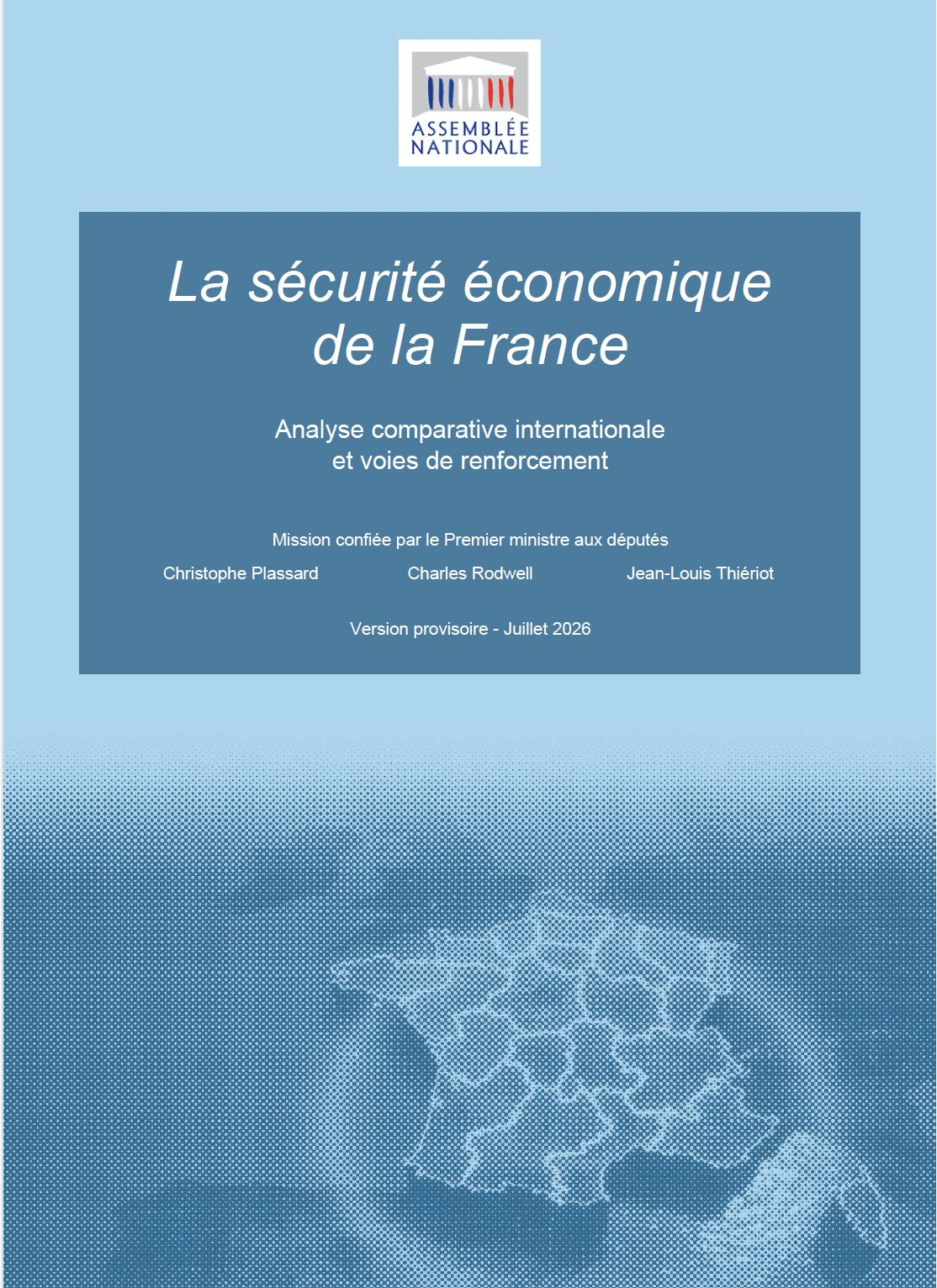
With the release of the report “France’s Economic Security – International Comparative Analysis and Avenues for Strengthening”, members of parliament Christophe Plassard, Charles Rodwell and Jean-Louis Thiériot are proposing a genuine doctrinal shift in how France approaches strategic risk.
The diagnosis is clear. Geopolitical upheaval, trade tensions, technological competition and the proliferation of influence strategies call for a new approach to economic security.
The report does not stop at taking stock of the situation. It puts forward concrete proposals designed to durably strengthen the state’s capacity to act, improve coordination among public actors and build a genuine national culture of economic security.
For practitioners working on sensitive transactions, this document is arguably the most important publication since France’s foreign investment screening regime was reformed.
The “France’s Economic Security” report sets out proposals aimed at strengthening the protection of French companies, technologies and strategic assets.
⸻
Why does this report mark a turning point?
Until now, economic security was often viewed as essentially an administrative competence, mobilized primarily during the review of foreign investment filings.
The report proposes a far more ambitious approach.
Its authors take the view that protecting strategic interests can no longer rest solely on an after-the-fact screening mechanism. It calls for an integrated public policy bringing together industrial policy, innovation, economic intelligence, technological sovereignty, supply chain resilience, financing for strategic companies and the anticipation of geopolitical risk.
In other words, economic security is becoming a cross-cutting objective of public action.
⸻
Foreign investment screening is now just one tool among several for economic security
One of the report’s key takeaways is that foreign investment screening is no longer anything more than one instrument among others.
The French regime remains essential to protecting strategic companies against certain changes of control that could harm national interests.
But the report stresses that economic security cannot be reduced to an administrative procedure.
It also encompasses:
- control over critical technologies;
- the protection of industrial know-how;
- dependencies on critical raw materials;
- cybersecurity;
- the protection of sensitive data;
- the risk of foreign interference;
- the resilience of value chains;
- the state’s financial intervention capacity.
This approach is fully consistent with the trends observed across the major Western economies.
⸻
What does this mean for M&A transactions?
For investors and M&A practitioners, the report fundamentally changes how sensitive transactions should be read.
For a long time, the analysis focused mainly on whether regulatory thresholds were crossed and on preparing an authorization filing.
Going forward, a transaction will need to demonstrate its compatibility with the economic security objectives pursued by public authorities.
Authorities will naturally pay close attention to:
- the credibility of the industrial project;
- the preservation of French strategic capabilities;
- the location of critical activities;
- technological dependencies;
- the future governance of sensitive assets;
- the continuity of supply chains;
- the acquirer’s investment capacity;
- the creation of industrial value in France.
This shift further reinforces the importance of preparing transactions very far upstream.
Institutional dialogue can no longer be treated as a mere procedural step.
It becomes an essential element of transaction strategy.
⸻
An approach that now goes beyond the question of capital alone
The report also shows that the administration is developing a much broader view of risk.
The analysis no longer focuses solely on the investor’s origin.
It now takes in the entire ecosystem within which the transaction sits.
Economic security accordingly leads to an examination of:
- industrial dependencies;
- the technologies held;
- logistics chains;
- international partnerships;
- critical infrastructure;
- strategic data;
- future production capacity.
This shift is gradually bringing France closer to the approaches developed by several of its international partners.
⸻
A shift in the state’s posture
One of the report’s strongest messages is its call to move away from a primarily defensive logic.
The rapporteurs argue for a more proactive policy, combining protection, anticipation and investment capacity.
Among their recommendations:
- strengthening national doctrine;
- improving interministerial coordination;
- building a culture of economic security among companies;
- strengthening public financial capacity;
- improving the protection of critical technologies;
- continuously adapting to new forms of interference.
This shift is likely to have a lasting influence on French public policy.
⸻
Pascal Dupeyrat’s contribution to the parliamentary mission
As part of this mission, Pascal Dupeyrat was heard by the rapporteurs. His written submission is reproduced as an annex to the parliamentary report.
This contribution builds on more than twenty years of work by RELIANS on the interplay between foreign investment, industrial sovereignty and M&A transactions.
It highlights several ideas that appear particularly timely today:
- treating foreign investment screening as a genuine economic sovereignty safeguard;
- anticipating institutional risk from the earliest stage of structuring a transaction;
- moving beyond a purely legal approach to screening;
- factoring geopolitical considerations into transaction analysis;
- developing a comprehensive view of economic security that brings together regulation, industrial strategy and competitiveness.
This approach is precisely the positioning RELIANS has built its practice around: helping investors understand what French authorities expect, in order to strengthen legal certainty and deal certainty.
⸻
Why investors need to plan further ahead
The report’s central lesson is probably this one.
The success of a sensitive transaction will depend less and less on the quality of the administrative filing alone, and increasingly on the overall coherence of the project presented to the authorities.
Economic security is progressively becoming a benchmark against which the industrial strategy itself is assessed.
Investors who build these considerations into their planning from the earliest stages will have a significant advantage in their dialogue with the relevant authorities.
Conversely, projects developed without regard for these new expectations are likely to run into greater difficulty during the review process.
⸻
RELIANS’s role
For more than twenty years, RELIANS has advised international investors, investment funds, investment banks, law firms and industrial groups facing the challenges of sensitive transactions.
Our approach rests on a simple conviction: strategic transactions can no longer be analyzed from a purely legal standpoint.
Understanding institutional expectations, sovereignty considerations, geopolitical risk and economic security objectives is now a decisive factor in success.
In an environment marked by tightening state controls and rapidly evolving public policy, anticipation has become a genuine competitive advantage.
The parliamentary report confirms this trend. It shows that economic security is no longer a matter reserved to government agencies. It is becoming a structuring parameter of corporate strategy, of how M&A transactions are executed, and of France’s attractiveness to investment.
⸻
Relians — Securing your acquisition in a sensitive sector
Securing an acquisition in a sensitive sector is not simply a matter of putting together a compliant filing.
Whether a transaction is feasible depends on its ability to be accepted within a given regulatory, institutional and political environment.
That requires:
• anticipating the state’s actual expectations
• identifying potential sticking points
• understanding the conditions that trigger certain reviews
• structuring the transaction accordingly
• and managing the relationship with the administration throughout the review process
“An acquisition in a sensitive sector is not something you undergo. It is something you build and manage.”
⸻
Relians — Assessing your actual exposure before you commit
Every foreign investment transaction in France carries its own level of risk, and that risk is not limited to legal compliance.
What ultimately matters is how the authorities actually perceive the transaction.
Before entering into or continuing a transaction, it is essential to quickly assess:
• the actual sensitivity of the activity
• the investor’s profile within its geopolitical context
• how the intended investment is structured
• points of tension likely to emerge during review
• the risk of restrictive conditions, sanctions or blocking
Some transactions fail not because they are prohibited, but because their level of risk was not sufficiently anticipated.
Access the strategic diagnostic
Strategic diagnostic – sensitive transactions
⸻
Relians — Stepping in to secure execution of your transaction
In many transactions, the risk is not apparent at the outset.
It emerges during the review process, as the analysis evolves in light of the investor, the investment or the activity involved.
That is the moment when the outcome tips one of three ways:
→ a transaction that can proceed
→ a transaction that is blocked
→ or a transaction accepted subject to restrictive conditions
Discuss your transaction with us, in confidence
Speak with an expert in sensitive transactions and foreign investment screening
⸻
“In sensitive transactions, success depends on the ability to make the investment acceptable before it is ever reviewed.”