Parliamentary Conference of 10 June 2026: What Future for France FDI Screening?
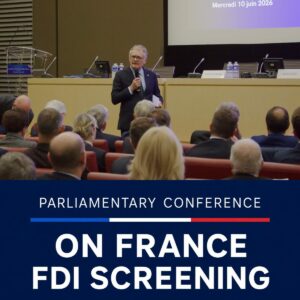
The parliamentary conference held on 10 June 2026 and dedicated to France FDI screening confirmed a profound shift in the public debate. Long treated as a technical matter reserved for public administrations, specialized lawyers and practitioners involved in sensitive transactions, France FDI screening has now become a political, economic and strategic issue.
It now lies at the intersection of national sovereignty, economic security, territorial attractiveness, innovation financing and the State’s ability to protect the essential interests of the Nation. The debate is no longer limited to the prior authorization procedure. It concerns the way in which France intends to organize its economic openness in an international environment shaped by technological competition, industrial power dynamics and the increasing use of extraterritorial instruments.
The formula that best summarized the discussions was straightforward: France is open, but it is not for sale.
This line of balance ran through both roundtables. The first, dedicated to “Economic sovereignty and France FDI screening: from France to Europe”, examined the relationship between the national and European levels. The second, dedicated to “What future for the French doctrine on France FDI screening?”, focused on the clarity of the French mechanism, its blind spots and its possible evolution.
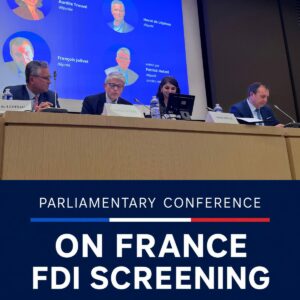
The conference brought together a high-level group of public officials, parliamentarians, European representatives and practitioners involved in sensitive transactions, including:
Michel Barnier, former Prime Minister of France, former European Commissioner and former EU Chief Negotiator for Brexit;
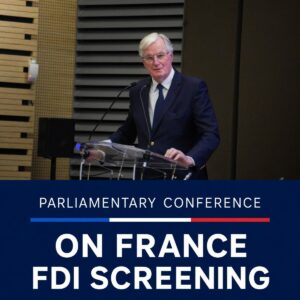
Roland Lescure, French Minister for the Economy, Finance and Industrial, Energy and Digital Sovereignty
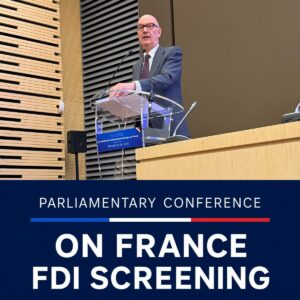
Arnaud Montebourg, former Minister of the Economy, Industrial Renewal and Digital Affairs;
Michèle Alliot-Marie, former French Minister of Foreign and European Affairs, former Minister of the Interior and former Minister of Defence;
Philippe Juvin, Member of the French National Assembly and General Rapporteur of the Finance Committee;
Patrick Hetzel, Member of the French National Assembly for Bas-Rhin;
Damien Levie, Adviser on Economic Security Tools and Technology at the European Commission’s Directorate-General for Trade and Economic Security;
and Pascal DUPEYRAT, strategic adviser and France FDI screening expert.

Against this institutional and professional background, the conference highlighted a clear point of convergence: France FDI screening must be strengthened, but it must not become a signal of economic closure.
The issue is not to discourage foreign capital that is useful to growth. The issue is to distinguish investments that are compatible with France’s strategic interests from those that may create dependency, vulnerability or loss of control.
Economic Sovereignty and France FDI Screening: From France to Europe
The first roundtable focused on the articulation between France and Europe. France FDI screening remains, first and foremost, a national instrument, because the decision to authorize, condition or prohibit a transaction directly concerns public order, public security and national defense interests.

The final decision must therefore remain in the hands of the Member State concerned. This is a matter of political responsibility, but also of practical knowledge of the industrial fabric, critical technologies, subcontracting chains, territorial dependencies and weak signals of economic security.
However, the European framework is becoming increasingly important. The reform of the European foreign investment screening framework aims to strengthen coordination between Member States, improve information-sharing and better identify cross-border risks. This development is necessary: a transaction carried out in one Member State may affect the security, industrial autonomy or critical infrastructure of another Member State.

In this context, Europe may become a multiplier of national sovereignty, provided that it does not become an additional layer of delays, uncertainty and procedural complexity. France FDI screening must not become one component of a superposition of contradictory filters. It must be organized within an effective European cooperation framework serving better-informed national decisions.
One of the central questions is therefore the precise added value of the European level. Is its purpose to inform, coordinate, alert, foster a common doctrine or exert political pressure on national decisions? The conference made it possible to raise this question directly. France FDI screening cannot be conceived as a transfer of sovereignty to Brussels. It should instead be understood as a national decision-making mechanism supported by reinforced European coordination, without dispossessing Member States of their authority.
The French paradox was also underlined. On certain points, France now appears less demanding than the emerging European screening framework. While Europe is tending to broaden the scope of sensitive sectors and impose a more homogeneous minimum baseline, French law still contains areas of uncertainty.
This discrepancy calls for clarification. If France wants to continue presenting itself as a balancing power, capable of being both attractive and protective, France FDI screening must remain coherent with the level of European ambition.
This European discussion cannot be separated from the issue of attractiveness. The Draghi report of September 2024 recalled the scale of Europe’s investment needs, estimated at several hundred billion euros of additional investment each year. It also emphasized Europe’s relative decline compared with the United States, particularly in terms of real disposable income per capita since 2000.
France FDI screening must therefore be placed within a broader equation: protecting strategic assets without drying up the capital flows needed to finance industry, energy, defense, digital infrastructure and critical technologies.
The real issue is not to oppose sovereignty and attractiveness. It is to build a doctrine of discernment. France must be able to welcome foreign investors when they contribute to industrial development, innovation, employment, competitiveness and the consolidation of strategic sectors. But through France FDI screening, it must also be able to impose conditions, require guarantees, organize post-authorization monitoring and prohibit a transaction when the risks to the national interest are too high.
What Future for the French Doctrine on France FDI Screening?
The second roundtable identified several points of agreement regarding the future of the French doctrine on France FDI screening.
The first concerns the expansion of the number of controlled sectors. Economic threats are no longer limited to traditional defense sectors or critical infrastructure. They now concern data, artificial intelligence, semiconductors, cloud infrastructure, cybersecurity, healthcare, energy, systemic financial services, critical raw materials, logistics chains and dual-use technologies.
France FDI screening must follow this expansion of the strategic field. It cannot remain frozen in an outdated sector-based approach while vulnerabilities are shifting toward technologies, data flows, supply dependencies and industrial architectures.
The second point concerns greenfield investments. The creation of a new facility in France may, in certain cases, produce effects comparable to an acquisition. It may allow access to technology, the capture of data, the creation of industrial dependency, control over critical production capacity or lasting influence over a local ecosystem.
France FDI screening must therefore integrate this dimension more clearly. The question is not only whether a French company changes control. It is also whether a new investment may create a strategic risk for France.
The third point concerns parliamentary oversight. Strengthening such oversight is not intended to politicize every transaction. Its purpose is to provide the mechanism with democratic readability. In a field where decisions are often covered by business secrecy, industrial confidentiality or national security requirements, it is essential to strike a balance between operational confidentiality and democratic accountability.
France FDI screening involves structural choices for the sovereignty of the country. It is therefore legitimate for Parliament to have, ex post, a consolidated view of major trends, sectors concerned, conditions imposed and decisions taken.
The fourth point concerns transparency in public life. Dialogue between companies, investors, advisers, administrations and public decision-makers is necessary. It is part of the reality of sensitive transactions. But this dialogue must be rigorous, traceable and consistent with the applicable rules on interest representation.
France FDI screening must not become an informal and opaque space. It must be governed by transparency rules compatible with the confidentiality of individual cases and the protection of strategic interests.
The fifth point concerns the establishment of a doctrine. Investors need predictability. Sellers need timetable certainty. Advisers need reference points. Administrations need a stable framework for reviewing cases.
A French doctrine on France FDI screening does not mean that the State gives up its margin of appreciation. It means that the criteria, expectations, typical risks, remedy requirements and points of vigilance must be more readily identifiable.
Such a doctrine should notably address authorization conditions, undertakings required from investors, governance arrangements, the location of sensitive assets, data protection, continuity of supply, State information rights, post-closing notification obligations and monitoring of commitments.
It should also clarify the role of preliminary review, which can secure the qualification of a transaction at an early stage and avoid major transaction delays.
The Role of SISSE in the Early Detection of Economic Security Alerts
The Minister for the Economy also recalled the role of SISSE in the early detection of economic security alerts. This point is central.
France FDI screening does not begin when a formal application is filed. It begins much earlier, with the State’s ability to detect weak signals, identify vulnerabilities, map strategic assets, identify dependencies and coordinate information between administrations.
This early detection capability is an essential condition for the effectiveness of the mechanism. France FDI screeningcannot operate solely as a reactive administrative procedure. It must be part of a broader economic security continuum, combining economic intelligence, knowledge of industrial sectors, ownership analysis, dialogue with companies and monitoring of critical value chains.
A Major Transaction Issue for Investors and Target Companies
The conference also made it possible to reconnect France FDI screening with the practical reality of transactions. For an investor, FDI risk is not merely a regulatory risk. It is a timetable risk, a documentation risk, a communication risk, a governance risk, a valuation risk and a closing risk.
For a seller, it is a factor of deal certainty. For an investment bank, it is a structuring element of the competitive process. For a strategic adviser, it is a question of institutional reading, preparation of the file, anticipation of State expectations and control of the dialogue with the authorities.
France FDI screening must therefore be integrated from the beginning of the transaction. It cannot be treated as an administrative formality at the end of the process. The qualification of the investor, the nature of the transaction, the scope of sensitive activities, the existence of public contracts, the presence of dual-use technologies, the location of data, supplier dependencies, the governance structure and the communication strategy must all be analyzed upstream.
This anticipation is particularly important where the transaction concerns sensitive sectors or investors subject to extraterritorial constraints. The undertakings requested by the State may have a direct impact on the governance of the target, the investor’s information rights, the location of critical activities, data security or the continuity of relations with public-sector customers.
In that respect, France FDI screening is no longer only a legal authorization issue. It has become a central component of transaction strategy, deal certainty and institutional risk management.
Protecting Without Closing: A Doctrine of Balance
The conclusion of the conference is clear: France must remain open to foreign investment, but it must have a robust, predictable and clearly assumed mechanism. Economic openness only makes sense if it is accompanied by the ability to protect the essential interests of the Nation.
Attractiveness is not inconsistent with sovereignty. On the contrary, it requires a clear, credible and controlled framework. A serious investor will prefer a demanding but readable France FDI screening mechanism to an uncertain, unpredictable framework subject to late-stage political arbitration.
From this perspective, France FDI screening should evolve in three directions.
First, a reasonable and coherent broadening of the scope of sensitive activities, in order to better take into account critical technologies, systemic financial services, digital infrastructure, data and strategic value chains.
Second, a more readable French doctrine, enabling investors and advisers to better anticipate State expectations and secure transactions upstream.
Third, a European articulation that strengthens Member States without dispossessing national authorities of their decision-making power.
France is open, but it is not for sale. This formula does not reflect a protectionist reflex. It expresses a doctrine of balance: welcoming useful capital, protecting critical assets, maintaining investor confidence, strengthening economic security and preserving the State’s decision-making capacity.
For foreign investors, industrial groups, funds, investment banks and advisers involved in sensitive transactions, the message is direct: France FDI screening must be anticipated, documented and integrated into the transaction strategy.
Only under this condition can France FDI screening cease to be perceived as a regulatory hazard and become a tool for securing the deal.
Going Further
Our approach consists in qualifying risk at an early stage, structuring the file, anticipating the expectations of the State and securing transaction execution.
In sensitive transactions, mastering the balance between investment logic and State expectations is what makes execution possible.
Relians is a strategic advisory firm specializing in international transactions exposed to France FDI screening and economic security issues.