The French FDI Decree Brings Nasdaq and the NYSE Within France’s 10% Screening Threshold
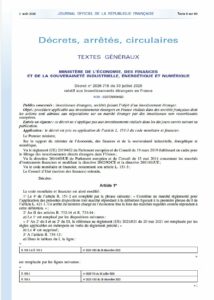
Decree No. 2026-718 of 30 July 2026 runs to a handful of lines. It amends a single paragraph of the French Monetary and Financial Code and tidies up a reference to the overseas territories. Read alongside the ministerial order signed and published on the same day, it does something considerably larger. The French FDI decree redefines which trading venues count for the purposes of French investment screening, and in doing so it brings a substantial population of French issuers listed outside France within the 10% notification mechanism for the first time.
Both texts appeared in the Journal officiel on Sunday 2 August 2026. They will apply from Monday 17 August 2026, the eleventh business day following publication. Deal teams therefore have a short window in which the previous framework still governs.
⸻
What the French FDI decree actually changes
One clarification is needed at the outset, because early press coverage has got this wrong. The 10% voting rights threshold is not new and has not been lowered. It was introduced on a temporary basis by Decree No. 2020-892 of 22 July 2020, then made permanent by Decree No. 2023-1293 of 28 December 2023 with effect from 1 January 2024. It applies only to investors from outside the European Union and the European Economic Area, and only where the target carries on one of the sensitive activities listed in Article R. 151-3.
What the French FDI decree changes is the denominator. Article R. 151-2, 4° catches the crossing of 10% of the voting rights in a French company whose shares are admitted to trading on a regulated market. Until now, practitioners read “regulated market” through the lens of French securities law, which meant Euronext Paris and, on a generous reading, EEA venues. The reform severs that link and replaces it with a purpose-built administrative list.
It is worth recalling what the mechanism involves, because it is lighter than full authorisation. Under the third paragraph of Article R. 151-5, the investor files a prior notification with the Treasury. Absent opposition by the Minister within ten business days, the dispensation from prior authorisation arises automatically. The cost of filing is low. The cost of not filing is not, and we return to that below.
⸻
The bespoke definition of regulated market behind the French FDI decree
The technical heart of the reform sits in the drafting of the cross-reference. The decree refers to the first sentence of Article L. 421-1, I of the French Monetary and Financial Code, which sets out the functional definition of a regulated market as a multilateral system operating under non-discretionary rules. It deliberately leaves out the second sentence, which confines the concept to markets formally recognised under French financial markets legislation.
That omission creates an autonomous notion of regulated market applicable to investment screening alone. A venue that is not a regulated market for the purposes of French securities law may nonetheless be one for the purposes of Article R. 151-2. The French FDI decree therefore decouples screening from capital markets regulation, and hands the perimeter to a ministerial order that can be amended far more quickly than a decree adopted after review by the Conseil d’État.
⸻
Which exchanges the French FDI decree brings into scope
The order that accompanies the French FDI decree inserts a new Article 5-1 into the order of 31 December 2019 and establishes three categories.
The first covers regulated markets in the European Union and the European Economic Area appearing on the register maintained by ESMA under Article 56 of MiFID II. This register is dynamic, so the relevant date is the date of the crossing rather than the date of signing.
The second covers third-country markets benefiting from an equivalence decision adopted under Article 25(4)(a) of Directive 2014/65/EU. Three such decisions remain in force, concerning Australia (Implementing Decision (EU) 2017/2318), Hong Kong (2017/2319) and the United States (2017/2320). The Swiss decision (2017/2441) lapsed on 30 June 2019.
The third names six exchanges outright: the London Stock Exchange, SIX Swiss Exchange, Toronto Stock Exchange, Singapore Exchange, Japan Exchange Group and Korea Exchange. The result is that the French FDI decree captures most major listing venues while retaining a closed and identifiable perimeter rather than a universal one.
⸻
Nasdaq, the NYSE and the question the French FDI decree does not answer expressly
Neither Nasdaq nor the New York Stock Exchange appears among the six named exchanges. A literal reading might suggest that French companies listed only in the United States escape the mechanism. That reading does not survive analysis.
Take the structure first. The six named exchanges correspond precisely to jurisdictions with no equivalence decision under Article 25(4)(a): the United Kingdom, Switzerland, Canada, Singapore, Japan and Korea. If the United States were excluded from the second category, that category would shrink to the ASX and HKEX alone. One would then have to accept that the drafter covered Sydney and Hong Kong while leaving out New York, at the very moment when US markets are the primary listing venue for French biotechnology and semiconductor issuers. That is not a plausible reading of a text reviewed by the Conseil d’État.
Take the wording second. The order refers to the legal basis of the equivalence decision, not to its regulatory purpose. The annex to Implementing Decision (EU) 2017/2320 lists twenty-one national securities exchanges registered with the SEC, including The Nasdaq Stock Market, Nasdaq BX, Nasdaq PHLX, New York Stock Exchange LLC, NYSE Arca, NYSE MKT (now NYSE American), NYSE National, the Chicago Stock Exchange (now NYSE Chicago), Cboe BZX, BYX, EDGA and EDGX, and IEX.
The counter-argument deserves to be stated fairly. Article 1 of Decision 2017/2320 opens with the words “for the purposes of Article 23(1) of Regulation (EU) No 600/2014”, which is the share trading obligation, and recital 30 limits its reach. The annex also lists thirty-three alternative trading systems, several of which are bank-operated dark pools that no one would describe as regulated markets in any functional sense. A restrictive reading is therefore arguable.
It does not carry, for two reasons. Article R. 151-2, 4° turns on admission to trading, and an alternative trading system admits nothing: it trades securities already admitted elsewhere. And the asymmetry of consequences settles the operational question whatever the doctrinal outcome. Failure to notify exposes the parties to nullity under Article L. 151-4 and to the financial penalty under Article L. 151-3-2, capped at the highest of twice the amount of the irregular investment, 10% of the target’s annual net turnover, and five million euros for legal persons. Against ten business days of standstill, the calculation is not close. Pending Treasury guidance, French issuers listed on Nasdaq or the NYSE should be treated as falling within the 10% mechanism.
⸻
The exchanges now in scope, in one place
Taken together, the decree and its order produce a single consolidated perimeter. A French issuer carrying on a sensitive activity is caught by the 10% mechanism where its shares are admitted to trading on any of the following:
- every regulated market in the European Union and the European Economic Area listed on the ESMA register, Euronext Paris included;
- the exchanges covered by the three surviving MiFID II equivalence decisions, which means Australia (ASX), Hong Kong (HKEX) and the United States, the US annex naming among others The Nasdaq Stock Market, Nasdaq BX, Nasdaq PHLX, New York Stock Exchange LLC, NYSE Arca, NYSE American, NYSE National, NYSE Chicago, Cboe BZX, BYX, EDGA and EDGX, and IEX;
- the six exchanges designated by name, namely the London Stock Exchange, SIX Swiss Exchange, Toronto Stock Exchange, Singapore Exchange, Japan Exchange Group and Korea Exchange.
Multilateral trading facilities stay outside all three categories, so Euronext Growth remains beyond the 10% threshold. The consequence is worth spelling out. A French company quoted on both Euronext Growth and Nasdaq was outside the mechanism until now and will be inside it from 17 August 2026, on the strength of its US listing alone. Several French biotechnology and semiconductor issuers sit in exactly that position.
⸻
Four traps in the consolidated list of venues covered by the French FDI decree
The annex to the US equivalence decision has not been updated since December 2017. MEMX, the Long Term Stock Exchange, MIAX Emerald, MIAX Sapphire and the Texas Stock Exchange are registered with the SEC but absent from it. On the letter of the text, a listing on one of those venues falls outside the perimeter.
The order designates operators rather than markets. Japan Exchange Group operates the Tokyo Stock Exchange and the Osaka Exchange. Korea Exchange operates KOSPI, KOSDAQ and KONEX. Singapore Exchange covers both the Mainboard and Catalist. More awkwardly, the London Stock Exchange operates AIM, which is a multilateral trading facility. The exclusion of MTFs that keeps Euronext Growth outside the regime is therefore less certain for AIM than it first appears.
The Toronto Stock Exchange is not the TSX Venture Exchange, which is a separate exchange within the same group. A French company quoted on the TSXV remains outside the mechanism.
Finally, the provision refers to shares admitted to trading. Several French issuers are present in the United States through American Depositary Shares rather than ordinary shares. Whether admission of a depositary receipt amounts to admission of the underlying share is unsettled, and it determines the answer for a meaningful part of the population the reform is aimed at.
⸻
Timing, and why deferred entry into force is not grandfathering
The French FDI decree and its ministerial order will apply from 17 August 2026. Transactions completed before that date remain governed by the previous framework. This is a deferred entry into force, not a grandfathering clause, and the distinction matters. The operative event under Article R. 151-2, 4° is the crossing of the threshold, not the signing of the agreement. A deal signed on 5 August and closed on 20 August will fall under the new perimeter.
Two further points bear on scope. The territorial limitation is unchanged, so the mechanism continues to apply only to investors falling outside the EU and EEA carve-out in Article R. 151-1, which is assessed by nationality for individuals and across the whole control chain for entities. And UK investors have been third-country investors since Brexit, which acquires new significance now that the London Stock Exchange sits on the list.
⸻
What the French FDI decree means for deal teams
Listing venue analysis has moved from a capital markets question to a regulatory gating item. The French FDI decree means that identifying the target’s country of incorporation and sector is no longer enough. Advisers now have to establish every venue on which the target’s securities are admitted, test each against the three categories, and do so at target screening stage rather than at signing.
The perimeter is also more mobile than before. Because it rests on a ministerial order rather than a decree, it can be amended quickly. Add Regulation (EU) 2026/1386, which entered into force on 16 July 2026 and applies from 17 January 2028, and the direction of travel is clear enough. French screening is converging on a broader mandatory scope, and the reform is a step taken in advance of it.
⸻
Working through the perimeter in practice
The practical questions raised by the French FDI decree are rarely resolved by reading the text alone. They turn on how the Treasury has handled comparable situations, on how a dual listing or an ADS programme is characterised, and on how a notification is framed so that the ten business days run cleanly rather than restarting on a request for information.
Relians works with listed issuers, private equity sponsors and cross-border M&A teams on exactly those questions: mapping listing venues against the new perimeter, assessing whether a contemplated stake build triggers Article R. 151-2, 4°, preparing notifications and prior activity requests, and sequencing French clearance within a wider multi-jurisdiction timetable. If you are looking at a French target with a listing outside Euronext Paris, the perimeter check is worth running before the teaser goes out rather than after.