Why Foreign Investment Regulation Is a Strategic Transaction Risk?
⸻
Understanding regulatory risk when investing in France
Understanding regulatory risk when investing in France has become an essential element of cross-border transaction planning. When international investors consider acquiring a French company or taking a stake in a strategic sector, regulatory considerations often arise at an early stage of the deal.
Foreign investment regulation in France is designed to protect national security, strategic technologies and critical infrastructure. As a result, certain transactions involving foreign investors may require prior authorization from the French Ministry of Economy.
For investors, understanding regulatory risk when investing in France is therefore essential in order to anticipate potential approval requirements before completing a transaction.

⸻
Why regulatory risk matters in cross-border transactions
In many international acquisitions, regulatory analysis is initially approached as a purely legal compliance issue. Investors often ask a simple question: will the transaction require approval from the authorities?
However, experienced investors increasingly recognize that regulatory risk when investing in France goes beyond a technical legal requirement. Regulatory considerations may affect the timing, structure and negotiation of a transaction.
For this reason, many investors now understand that:
Foreign investment regulation is not only a legal issue — it is a strategic transaction risk.
Evaluating regulatory risk when investing in France early in the transaction process allows investors to anticipate potential obstacles and structure deals accordingly.
⸻
Sources of regulatory risk when investing in France
Several factors can influence regulatory risk when investing in France.
The first factor concerns the nature of the investor. The nationality of the investor and the structure of the investment vehicle may affect how a transaction is perceived by regulatory authorities.
The second factor relates to the type of transaction. Acquisitions of control, minority investments granting significant governance rights and strategic partnerships may all trigger regulatory review.
The third factor concerns the activities of the target company. Companies operating in strategic sectors are more likely to fall within the scope of the foreign investment screening regime.
Understanding these factors is essential for assessing regulatory risk when investing in France.
⸻
Sensitive sectors and strategic technologies
The activities carried out by the target company play a central role in determining regulatory risk when investing in France.
Certain sectors are considered particularly sensitive because of their importance for national security and economic sovereignty. These sectors include in particular:
• defense-related activities
• critical infrastructure
• energy systems
• cybersecurity and telecommunications networks
• artificial intelligence and advanced technologies.
When a foreign investor plans to acquire a company operating in these sectors, the transaction may attract increased regulatory scrutiny. In such situations, regulatory risk when investing in France must be carefully evaluated before launching the transaction.
For investors and their advisors, identifying sector sensitivity is therefore a critical step in transaction preparation.
⸻
Institutional and geopolitical considerations
Foreign investment regulation cannot be understood solely through legal rules. In practice, regulatory risk when investing in France may also reflect broader institutional and geopolitical considerations.
Investments involving strategic technologies may attract particular attention in a context of increasing global competition for technological leadership. Governments may also be attentive to the strategic implications of foreign investments in sectors linked to national sovereignty.
As a result, regulatory risk when investing in France may depend not only on the formal legal framework but also on the broader institutional environment surrounding the transaction.
Understanding this context can therefore help investors anticipate potential sensitivities associated with their investment projects.
⸻
Regulatory timelines and deal planning
Another important dimension of regulatory risk when investing in France concerns transaction timing.
Foreign investment screening procedures typically include a regulatory review period during which authorities assess the potential implications of the investment.
In France, the review procedure generally includes an initial phase lasting up to 30 business days. If further analysis is required, the authorities may initiate a second phase lasting up to 45 additional business days.
These timelines mean that regulatory risk when investing in France can have a direct impact on transaction schedules, financing arrangements and deal execution.
Investors who anticipate these timelines early in the process are generally better positioned to manage regulatory uncertainty.
⸻
Assessing regulatory risk before launching a transaction
Because regulatory factors can influence transaction outcomes, investors increasingly conduct preliminary assessments of regulatory risk when investing in France before initiating an acquisition.
Such an assessment typically examines several key elements:
• the nationality and ownership structure of the investor
• the type of transaction being considered
• the activities carried out by the target company
• the potential sensitivity of the relevant sector.
Evaluating these elements at an early stage allows investors to better understand regulatory risk when investing in France and to adapt transaction structures accordingly.
This approach can significantly reduce uncertainty during the regulatory review process.
⸻
Why strategic analysis matters
For investors and financial institutions involved in cross-border mergers and acquisitions, regulatory considerations must be integrated into the overall transaction strategy.
Rather than approaching regulatory approval as a purely procedural step, investors increasingly recognize that regulatory risk when investing in France must be analyzed alongside financial, operational and commercial considerations.
Anticipating regulatory constraints early in the deal process allows investors to structure transactions more effectively and increase the likelihood of obtaining approval from the authorities.
In this context, the assessment of regulatory risk when investing in France becomes a key component of strategic transaction planning.
⸻
Strategic Risk Assessment
Before launching a cross-border acquisition, investors may benefit from conducting a preliminary evaluation of potential regulatory exposure.
Relians assists investors in assessing how foreign investment screening rules may apply to a planned transaction and how regulatory considerations could affect the structure or timing of the deal.
For investors preparing a transaction involving strategic sectors or sensitive technologies, a Strategic Risk Assessment can provide valuable insight into the potential regulatory landscape surrounding the investment.
Investors and advisors considering acquisitions in France are welcome to contact Relians to discuss their transaction and explore potential regulatory considerations.
For further information, please contact Relians to discuss your investment project.
⸻
Frequently asked questions about investing in France
Do foreign investors need approval to invest in France?
In certain situations, foreign investors must obtain authorization from the French Ministry of Economy before completing an investment. This typically applies when the transaction involves sensitive sectors or strategic technologies.
⸻
How long does foreign investment approval take in France?
The foreign investment review process usually includes an initial phase lasting up to 30 business days, followed by a potential second phase lasting up to 45 additional business days.
⸻
Can minority investments require approval in France?
Yes. Even minority investments may require approval when a foreign investor acquires significant voting rights in companies operating in sensitive sectors.
⸻
Further reading
For a detailed analysis of the French foreign investment screening regime, see:
France FDI Screening: Legal and Strategic Framework (English Edition)
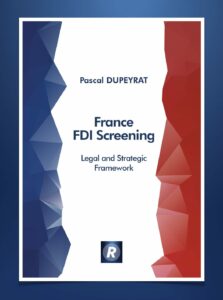
Author: Pascal DUPEYRAT
Publisher: Relians
Edition: English Edition — 1st edition
Print ISBN-13: 978-2-9584520-4-9
Ebook ISBN: 978-2-9584520-6-3
The book provides a comprehensive explanation of the legal foundations and strategic implications of the France foreign investment review regime, offering practical insights for investors, financial institutions and legal advisors navigating the foreign investment control France framework.
⸻