Investing in France: Foreign Investment Approval Rules and Regulatory Risks
⸻
France remains one of the most attractive destinations for international investors in Europe. The country offers a large domestic market, world-class infrastructure, advanced technologies and a highly skilled workforce. For many companies and investment funds, investing in France represents an opportunity to acquire strategic assets and expand their presence in the European market.
However, investing in France also requires investors to understand the regulatory framework governing foreign investment. In particular, certain transactions involving foreign investors may require prior authorization from the French Ministry of Economy under the French foreign investment screening regime.
For investors planning cross-border mergers and acquisitions, anticipating the regulatory implications of investing in France is therefore an essential step in structuring a successful transaction.

⸻
Foreign Investment Approval When Investing in France
When investing in France, foreign investors must assess whether their transaction falls within the scope of the French foreign investment approval regime, commonly known as the “Investissements Étrangers en France” (IEF) framework.
This regulatory mechanism allows the French government to review foreign investments that may affect national interests. In certain situations, investors must obtain prior approval before completing their transaction.
The requirement for foreign investment approval has become a key regulatory consideration for investors investing in France, particularly in sectors involving strategic technologies or critical infrastructure.
The legal basis of this mechanism is primarily found in Article L151-3 of the French Monetary and Financial Code. The review process is administered by the French Ministry of Economy, which assesses whether the proposed transaction could affect public order, public security or national defense.
For investors investing in France, understanding whether their transaction may require foreign investment approval is therefore a crucial element of transaction planning.
⸻
Sensitive Sectors When Investing in France
One of the most important questions for investors investing in France concerns the activities of the target company.
The French foreign investment approval regime applies particularly to companies operating in sectors considered strategic or sensitive. These may include activities related to defense, dual-use technologies, energy infrastructure, telecommunications, artificial intelligence, data processing or critical digital infrastructure.
In practice, transactions involving companies active in these sectors are more likely to trigger foreign investment approval requirements when investing in France.
Investors preparing acquisitions in these areas should therefore conduct a careful regulatory assessment before launching the transaction process. A detailed overview of these activities can be found in our analysis of
sensitive sectors for foreign investment in France.
Understanding the regulatory landscape affecting strategic sectors is a key step for investors investing in France.
⸻
The Foreign Investment Approval Process
The foreign investment approval process plays a central role for investors investing in France in sensitive sectors.
Once an application is submitted, the French Ministry of Economy reviews the transaction to determine whether it could affect national interests. This procedure may involve consultations with several government departments, depending on the activities of the target company.
The review may lead to several outcomes:
• approval of the transaction
• approval subject to certain commitments
• refusal of the transaction in exceptional circumstances.
In many cases, investors investing in France must negotiate specific commitments with the authorities in order to ensure that strategic interests remain protected.
Understanding how the
foreign investment approval process in France works is therefore essential for structuring cross-border transactions.
⸻
Timeline of Foreign Investment Approval
Another important aspect for investors investing in France concerns the duration of the review procedure.
The timeline of the foreign investment approval process may vary depending on the complexity of the transaction and the sensitivity of the activities involved.
Investors often need to integrate the expected regulatory timetable into the overall transaction schedule when investing in France. Anticipating the regulatory review can help avoid delays or unexpected conditions imposed by the authorities.
A detailed explanation of the regulatory timetable is available in our analysis of the
France FDI review timeline.
For investors investing in France, understanding these timelines is critical for managing deal execution.
⸻
Minority Investments and Foreign Investment Approval
Foreign investment approval rules may also apply to certain minority investments.
In some situations, investors investing in France may trigger the approval requirement even when acquiring only a limited stake in a French company. This may occur when the investment grants access to sensitive information or influence over strategic decisions.
This issue is particularly relevant for venture capital funds and strategic investors investing in France in high-technology sectors.
More information on this topic can be found in our article on
minority investments requiring approval in France.
Understanding these thresholds is essential when structuring minority investments investing in France.
⸻
Regulatory Risk When Investing in France
Foreign investment regulation should not be viewed solely as a legal formality. For investors investing in France, it represents a strategic transaction risk that must be managed carefully.
Failure to anticipate the regulatory review process may lead to delays, additional conditions imposed by the authorities or, in rare cases, the prohibition of a transaction.
For this reason, many investors seek expert advice when investing in France in sectors subject to foreign investment screening.
A strategic assessment conducted at an early stage of the transaction can help investors identify potential regulatory issues, structure the transaction appropriately and anticipate the expectations of the authorities.
⸻
Strategic Advisory for Investors Investing in France
Relians assists investors, companies and advisors involved in cross-border transactions requiring foreign investment approval.
Our team provides strategic advisory services combining regulatory analysis, institutional strategy and transaction support throughout the foreign investment screening process.
We help investors investing in France anticipate regulatory risks, structure transactions involving sensitive sectors and manage institutional dialogue with public authorities.
More information on our expertise can be found on our page dedicated to
foreign direct investment screening in France.
Investors preparing acquisitions investing in France can also consult our reference book
France FDI Screening – Legal and Strategic Framework, which provides a comprehensive analysis of the French foreign investment screening regime.
If you are planning a transaction investing in France, our team is available to discuss your project and help you anticipate regulatory risks.
→ Contact our team to discuss your investment project.
⸻
Strategic Risk Assessment
Investors considering investing in France may wish to assess at an early stage whether their transaction could require foreign investment approval or raise regulatory sensitivities.
Relians advises investors, private equity funds and financial institutions on the regulatory and strategic implications of cross-border transactions involving French companies.
A Strategic Risk Assessment can help identify potential regulatory exposure and anticipate how foreign investment screening may affect the structure or timing of a transaction.
For further information, please contact Relians to discuss your investment project.

⸻
Further reading
For a detailed analysis of the French foreign investment screening regime, see:
France FDI Screening: Legal and Strategic Framework (English Edition)
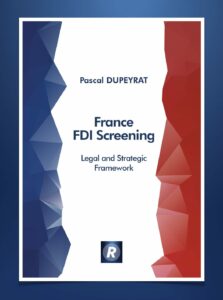
Author: Pascal DUPEYRAT
Publisher: Relians
Edition: English Edition — 1st edition
Print ISBN-13: 978-2-9584520-4-9
Ebook ISBN: 978-2-9584520-6-3
The book provides a comprehensive explanation of the legal foundations and strategic implications of the France foreign investment review regime, offering practical insights for investors, financial institutions and legal advisors navigating the foreign investment control France framework
⸻
“Investing in France is not just about opportunity — it is about anticipating regulatory acceptance.”