
Why foreign investment screening matters when investing in France?
⸻
A key factor in cross-border acquisitions
Investing in France offers significant opportunities for international investors seeking access to advanced industrial capabilities, technological expertise and a large European market.
However, investing in strategic sectors increasingly requires a careful assessment of foreign investment screening risk. This regulatory framework may influence not only the feasibility of an acquisition, but also its structuring, valuation and execution timeline.
For investors considering mergers, acquisitions or equity investments, understanding how foreign investment control has become essential.

⸻
What foreign investment screening means when investing in France?
Foreign investment screening is a regulatory mechanism through which the Minister of the Economy assesses whether a foreign investor’s participation in a French company could affect national interests.
When investing in France, this review focuses on activities linked to national defence, public order or public security. Depending on the circumstances, the investment may be authorized, authorized subject to conditions, or in rare cases refused.
The review process typically takes between 30 and 75 business days.
For international investors, this framework illustrates how economic security considerations increasingly shape the environment for investing in France.
⸻
Why foreign investment screening matters when investing in France?
For many investors, investing involves more than identifying attractive targets. It also requires anticipating transaction risks linked to regulatory review.
Failure to assess foreign investment exposure when investing may lead to:
• delayed closing
• renegotiation of deal terms
• governance constraints
• industrial or technological commitments
• perimeter adjustments
• reputational exposure
Integrating these risks early into transaction strategy helps investors secure deal execution and preserve value when investing in France.
⸻
When foreign investment screening is triggered?
Foreign investment control applies when three cumulative conditions are met in the context of investing :
• the investor qualifies as a foreign investor
• the investment targets a French-law entity
• the target operates in a sensitive activity
Eligible transactions typically include acquisitions of control, partial acquisitions of business lines, or the crossing of certain shareholding thresholds.
Conversely, the mere creation of a French subsidiary or certain intra-group restructurings may fall outside the scope of review.
⸻
How foreign investors are defined when investing in France?
The French regulatory framework adopts a broad definition of foreign investors to ensure effective oversight of strategic assets.
Foreign investors may include:
• individuals of foreign nationality
• French nationals not domiciled in France for tax purposes
• foreign legal entities
• French companies controlled by foreign persons or entities
Understanding this definition is crucial for structuring transactions appropriately.
⸻
Sensitive sectors affecting investing in France
Foreign investment screening applies to a wide range of strategic sectors.
When investing in France, particular attention should be paid to activities involving:
- Activities sensitive by nature
- Defence-related operations, dual-use technologies, cybersecurity services, cryptology, data processing and communication interception technologies.
- Critical infrastructure and essential services
- Energy supply, transport networks, electronic communications, water services, public health systems and vital industrial facilities.
- Strategic technologies and research
- Artificial intelligence, semiconductors, quantum technologies, biotechnology, robotics and low-carbon energy technologies.
For investors, these sectors combine strong growth potential with increased regulatory scrutiny when investing in France.
⸻
The main stages of foreign investment review
The screening procedure typically includes two phases that may influence deal execution when investing in France.
Phase 1 – Initial review
During this preliminary stage, lasting up to 30 business days, the Minister may:
• confirm that the investment falls outside the scope of review
• authorize the transaction without conditions
• initiate an in-depth review
Phase 2 – In-depth review
This second phase may extend for an additional 45 business days. At its conclusion, authorities may authorize the investment, impose commitments or refuse authorization.
These outcomes may significantly affect transaction timelines and structuring decisions.
⸻
Legal framework governing investing in France
Foreign investment screening is governed by Articles L.151-1 et seq. and R.151-1 et seq. of the French Monetary and Financial Code.
These provisions establish the principle of freedom of investment while allowing prior authorization mechanisms to protect national interests.
European cooperation mechanisms, including Regulation (EU) 2019/452, also play a role in shaping the environment.
⸻
Why early strategic assessment is essential when investing in France?
Investors who assess regulatory exposure early when investing in France are better positioned to:
• secure internal investment approvals
• design robust deal structures
• anticipate regulatory timelines
• manage institutional perception
• maintain negotiation leverage
Strategic anticipation transforms uncertainty into a manageable parameter of deal execution.
⸻
How to mitigate foreign investment risk when investing in France?
Mitigating regulatory risk requires a structured and forward-looking transaction strategy. Investors investing in France must evaluate how screening procedures may affect structuring choices, valuation assumptions and financing conditions.
In practice, risk mitigation may involve adjusting the acquisition perimeter, sequencing investments over time, reconsidering governance arrangements or preparing commitments aligned with industrial or national security priorities.
Relians supports international investors investing in France through a dedicated strategic diagnostic designed to provide a clear and actionable assessment of transaction exposure. This advisory approach goes beyond regulatory analysis by integrating institutional perception, sector sensitivity and potential structuring options.
Investors investing in France are encouraged to assess their exposure at an early stage and to engage with experienced advisors to secure execution certainty and protect deal value.
⸻
Further Reading
France FDI Screening – Legal and Strategic Framework
Pascal DUPEYRAT – Relians
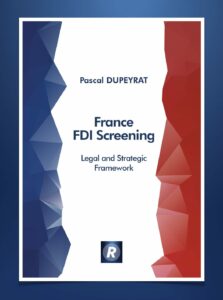
This book provides a comprehensive analysis of the French foreign investment control regime, including its legal foundations, its interaction with European and international frameworks such as CFIUS, and its implications for transaction strategy.
⸻
Our Expertise – Relians
Relians is a strategic advisory firm specialized in foreign investment screening and economic security.
For more than twenty years, Relians has supported international investors, private equity funds and industrial groups in navigating complex regulatory environments and securing cross-border transactions.
The firm combines legal expertise, transactional experience and institutional insight to assist clients at every stage of the process, from initial assessment to regulatory approval.
⸻
Why investors rely on Pascal Dupeyrat for foreign investment risk advisory?
Pascal DUPEYRAT is a strategic advisor specialising in foreign investment screening and sensitive cross-border transactions in France. Over more than two decades, he has supported international investors, corporate groups and financial advisors in navigating complex regulatory environments and structuring acquisitions involving strategic assets.
His advisory approach combines legal analysis, institutional insight and transaction structuring expertise, allowing investors to anticipate regulatory expectations, manage execution risk and preserve deal value. He is also the author of France FDI Screening: Legal and Strategic Framework, a reference work providing practical guidance on the strategic dimensions of foreign investment control.
Through Relians, Pascal DUPEYRAT supports investors at key stages of their transactions, from preliminary risk assessment to institutional dialogue and deal execution strategy.
⸻