
Do Minority Investments Require Approval in France?
⸻
Understanding Minority Investment Rules Under the French Foreign Investment Screening Regime
Foreign investors frequently acquire minority stakes in French companies as part of strategic partnerships, venture capital investments, or private equity transactions. In many jurisdictions, minority investments do not automatically trigger regulatory review. However, the French foreign investment screening regime can apply even when an investor acquires only a limited shareholding. Understanding when a minority investment may require authorization is therefore an essential question for investors navigating minority investment France approval rules.
Under certain circumstances, a minority stake may fall within the scope of the foreign investment screening regime, particularly when it involves companies operating in strategic sectors. In such cases, the investment may require authorization from the French Ministry of the Economy. The regulatory framework governing minority investment France approval therefore plays an important role in structuring cross-border investments.
One of the most frequently discussed elements of the regulatory framework is the 10 percent rule France foreign investment, which applies in specific situations involving publicly listed companies.

⸻
Minority Investments and Foreign Investment Control
Foreign investors often assume that regulatory review applies only when they acquire full control of a company. However, under the French foreign investment screening framework, certain minority acquisitions may still require authorization.
The concept of minority investment France approval reflects the idea that even a limited shareholding may provide access to strategic information or influence over sensitive activities. As a result, the authorities may examine certain minority investments when they involve companies operating in sectors considered critical for national security or technological sovereignty.
This approach explains why the minority investment France approval framework extends beyond traditional acquisitions of control. Investors should therefore carefully evaluate the regulatory implications of any minority transaction involving a French company.
⸻
The Importance of the 10 Percent Rule
One of the most distinctive aspects of the French system is the 10 percent rule France foreign investment, which applies to specific investments in publicly listed companies.
Under this rule, when a non-European investor acquires more than ten percent of the voting rights of a company listed on a regulated market, the investment may fall within the scope of the foreign investment screening regime if the company operates in sensitive sectors.
The 10 percent rule France foreign investment was introduced to ensure that strategic companies cannot be influenced by foreign investors through relatively small shareholdings. Because listed companies may have dispersed ownership structures, even a minority stake may provide significant influence.
As a result, transactions involving listed companies must be carefully analyzed to determine whether the 10 percent rule France foreign investment applies.
⸻
When Minority Investments Trigger Approval
Although minority investments are common in international business transactions, they may trigger regulatory review when certain conditions are met. The minority investment France approval requirement typically arises when the investor acquires rights that provide influence over a company operating in sensitive sectors.
In addition to the 10 percent rule France foreign investment, regulatory review may also occur when minority investors obtain governance rights such as board representation, veto rights or access to sensitive information.
These rights may allow the investor to influence strategic decisions or gain insight into critical technologies. For this reason, authorities may analyze such transactions within the minority investment France approval framework.
The combination of ownership thresholds and governance rights therefore plays a central role in determining whether a minority investment requires authorization.
⸻
Sensitive Sectors and Minority Investments
The sector in which the target company operates remains one of the most important factors in determining whether a minority investment may require approval.
When companies operate in sectors such as defense, cybersecurity, critical infrastructure or advanced technologies, authorities may apply stricter scrutiny under the minority investment France approval regime.
Even when the investor acquires only a limited stake, the presence of sensitive technologies may justify regulatory review. This explains why the 10 percent rule France foreign investment is particularly relevant in technology-driven sectors.
Investors should therefore analyze the nature of the target’s activities carefully before completing any minority investment transaction.
⸻
Minority Investments in Listed Companies
The 10 percent rule France foreign investment applies specifically to companies listed on regulated markets. Listed companies are often characterized by fragmented shareholding structures, meaning that a relatively small stake may provide meaningful influence.
For this reason, the regulatory framework includes the 10 percent rule France foreign investment as a mechanism to ensure that strategic listed companies remain protected.
When a non-European investor crosses this threshold in a company operating in sensitive sectors, the investment may trigger minority investment France approval requirements.
Because the rule focuses on voting rights rather than economic ownership, investors must carefully monitor their shareholdings to ensure compliance with the 10 percent rule France foreign investment.
⸻
Structuring Minority Investments
In practice, investors frequently structure transactions to ensure compliance with the minority investment France approval regime. This may involve careful planning of ownership percentages, governance rights and access to sensitive information.
Advisors often examine whether the 10 percent rule France foreign investment could apply before completing the transaction. By anticipating regulatory requirements early, investors can avoid delays and ensure that the transaction proceeds smoothly.
For venture capital funds, private equity investors and multinational corporations, understanding the minority investment France approval framework is therefore an important part of transaction planning.
⸻
Why Early Regulatory Analysis Matters
Conducting regulatory analysis early in the transaction process helps investors determine whether their investment may fall within the scope of minority investment France approval rules.
Early assessment allows investors to identify whether the 10 percent rule France foreign investment might apply and whether authorization from the authorities may be required before closing the transaction.
This proactive approach reduces uncertainty and allows investors to integrate regulatory considerations into the deal structure. Legal advisors and regulatory specialists frequently assist investors in navigating the minority investment France approval process.
⸻
Strategic Assessment for Minority Investments
Transactions involving minority stakes in strategic sectors can sometimes raise complex regulatory questions. Investors may therefore benefit from obtaining a strategic assessment before completing an acquisition.
Relians provides regulatory and strategic assessments for international investors and financial institutions considering minority investments in France. This analysis helps determine whether the transaction may fall within the minority investment France approval regime and whether the 10 percent rule France foreign investment could apply.
Investors planning a transaction may request a preliminary strategic assessment by contacting Relians directly:

⸻
Learn More About Minority Investment France Approval
For a comprehensive analysis of the legal and strategic framework governing foreign investment screening in France, investors and advisors may consult the reference book:
France FDI Screening: Legal and Strategic Framework (English Edition)
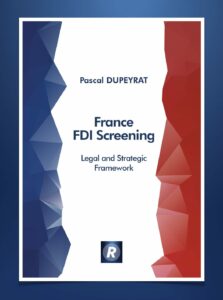
Author: Pascal DUPEYRAT
Publisher: Relians
Edition: English Edition — 1st edition
Print ISBN-13: 978-2-9584520-4-9
Ebook ISBN: 978-2-9584520-6-3
The book provides a detailed explanation of the regulatory framework governing minority investment France approval, including the application of the 10 percent rule France foreign investment, sensitive sectors and practical guidance for investors navigating the French foreign investment screening regime.
⸻