What Are the Sensitive Sectors for France Foreign Investment?
⸻
Understanding Strategic Activities Under the French Investment Screening Regime
France remains one of Europe’s most attractive destinations for international capital. Its strong industrial base, advanced technological ecosystem, and access to the European market make it a key location for acquisitions and strategic partnerships.
At the same time, the French government maintains a regulatory framework designed to review foreign investments that may affect national security or strategic economic interests. As part of this framework, investors must pay particular attention to the sensitive sectors identified under the France foreign investment regime.
Understanding these sensitive sectors is essential for any investor considering a transaction involving a French company. Investments affecting these activities may require prior authorization from the French Ministry of the Economy before they can be completed. The France foreign investment screening regime therefore plays a central role in the regulatory analysis of many cross-border transactions.
However, identifying these sectors is only the first step. In practice, how authorities interpret sensitivity is what determines whether a transaction will be approved.

⸻
The Role of Sensitive Sectors in the France Foreign Investment Framework
The concept of sensitive sectors is at the core of the France foreign investment control mechanism. The French system is designed to remain open to international capital while ensuring that key industries and technologies remain protected when national interests are at stake.
Under the France foreign investment regime, the authorities review foreign investments only when certain conditions are met. One of the most important of these conditions is whether the target company operates in one of the designated sensitive sectors. These sectors are defined broadly and have expanded significantly over the past decade as technological and geopolitical considerations have evolved.
For investors and advisors involved in mergers and acquisitions, identifying whether a target company operates in sensitive sectors is therefore a critical step in assessing regulatory risk under the France foreign investment framework.
⸻
Defense and Military Activities
One of the most obvious categories within the sensitive sectors list concerns defense and military-related activities. Companies involved in the development, manufacturing, or maintenance of defense equipment are among the most closely monitored under France foreign investment rules.
These activities include the production of weapons systems, military electronics, aerospace defense technologies, and specialized defense software. Because such capabilities are considered vital to national security, foreign acquisitions affecting companies operating in these sensitive sectors are typically subject to review under the France foreign investment regime.
In practice, transactions involving defense-related companies almost always require careful regulatory analysis. Investors considering acquisitions in these sensitive sectors should anticipate the possibility of regulatory scrutiny within the France foreign investment process.
⸻
Dual-Use Technologies
Another important group of sensitive sectors involves technologies classified as dual-use. These are technologies that can serve both civilian and military purposes.
Examples include advanced electronics, aerospace technologies, high-performance materials, and certain computing technologies. Because these technologies may contribute to military or security-related applications, they often fall within the scope of France foreign investment screening.
Companies developing or commercializing dual-use technologies are therefore frequently included among the sensitive sectors monitored by authorities. When foreign investors acquire firms operating in these areas, the transaction may require authorization under France foreign investment regulations.
For investors in high-technology industries, identifying dual-use capabilities within a target company is an essential step in evaluating exposure to the France foreign investment regime.
⸻
Cybersecurity and Digital Security
The protection of digital infrastructure has become a central priority for governments worldwide. As a result, cybersecurity activities have been incorporated into the sensitive sectors covered by the France foreign investment framework.
Companies providing cybersecurity services, encryption technologies, or secure communications infrastructure may therefore fall within these sensitive sectors. Because these technologies are essential for protecting national digital infrastructure, foreign acquisitions involving such companies are often reviewed under France foreign investment rules.
Businesses involved in cryptography, network security, and information systems protection frequently operate within sensitive sectors recognized by the France foreign investment regime. Investors should therefore carefully evaluate whether the target company plays a role in safeguarding critical digital infrastructure.
⸻
Critical Infrastructure
Critical infrastructure represents another major category of sensitive sectors under the France foreign investment system. These are industries that provide essential services for the functioning of the national economy and public life.
Examples include sectors such as energy production, water supply, transportation systems, and telecommunications networks. Because disruptions in these sectors could affect national security or public order, companies operating in these sensitive sectors may fall within the scope of France foreign investment review.
Investments affecting operators of critical infrastructure are therefore often subject to regulatory scrutiny. The France foreign investment regime ensures that such assets remain protected when foreign investors acquire significant influence over companies operating in these sensitive sectors.
⸻
Advanced and Critical Technologies
In recent years, France has expanded the scope of its sensitive sectors to include several advanced technologies considered strategically important for future economic competitiveness.
These technologies include artificial intelligence, semiconductors, quantum computing, robotics, and advanced data processing technologies. Companies developing innovations in these areas may therefore be considered part of the sensitive sectors monitored under the France foreign investment framework.
Foreign investments affecting companies involved in these technologies may be reviewed because they could influence long-term technological sovereignty. As a result, transactions involving firms operating in these sensitive sectors may trigger the application of France foreign investment controls.
For investors in technology-intensive industries, assessing whether the target’s activities fall within these sensitive sectors is a critical component of the regulatory analysis.
⸻
Biotechnology and Health Security
The COVID-19 pandemic highlighted the strategic importance of health-related industries. As a result, biotechnology and certain healthcare technologies have increasingly been included among the sensitive sectors covered by the France foreign investment regime.
Companies involved in pharmaceutical research, vaccine development, advanced diagnostics, and biotechnology innovation may therefore fall within these sensitive sectors. Because such technologies are essential for public health security, foreign acquisitions involving these companies may require authorization under France foreign investment regulations.
Investors considering transactions in biotechnology or healthcare should therefore carefully evaluate whether the target’s activities place it within these sensitive sectors recognized by the France foreign investment system.
⸻
Data and Strategic Information
Data protection has also become an important component of modern economic security policies. As a result, certain companies handling large volumes of sensitive data may be included among the sensitive sectors monitored by the France foreign investment regime.
Organizations that process strategic industrial data, personal data at scale, or information related to critical infrastructure may fall within these sensitive sectors. Because such data can have strategic implications, foreign investments involving these companies may be reviewed under France foreign investment procedures.
The expansion of digital economies has therefore broadened the range of sensitive sectors considered relevant for France foreign investment control.
⸻
Why Identifying Sensitive Sectors Matters
For international investors, understanding the scope of sensitive sectors is essential before pursuing acquisitions in France. Early identification of these sectors allows investors to anticipate potential regulatory requirements and structure transactions accordingly.
Because the France foreign investment regime combines several criteria—investor nationality, transaction structure, and sectoral sensitivity—determining whether the target operates in sensitive sectors is often the decisive factor in assessing regulatory exposure.
Conducting this analysis at an early stage of a transaction helps investors avoid delays and uncertainty during the deal process. It also allows them to anticipate whether prior authorization may be required under France foreign investment regulations.
⸻
Learn More About France Foreign Investment Screening
For a comprehensive analysis of the legal and strategic framework governing foreign investment in France, investors and advisors may consult the reference book:
France FDI Screening: Legal and Strategic Framework (English Edition)
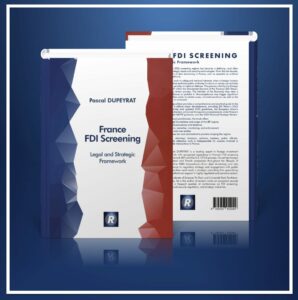
Author: Pascal DUPEYRAT
Publisher: Relians
Edition: English Edition — 1st edition
Print ISBN-13: 978-2-9584520-4-9
Ebook ISBN: 978-2-9584520-6-3
This book provides a detailed explanation of the legal foundations, sectoral scope, and strategic implications of the France foreign investment screening regime, offering practical guidance for investors, financial institutions, and legal advisors involved in international transactions.
⸻
Strategic Assessment for France Foreign Investment Transactions
In many transactions involving sensitive sectors, investors may need a more detailed analysis to determine whether their operation could fall within the scope of the France foreign investment review regime.
Relians provides strategic and regulatory assessments for international investors, financial institutions and legal advisors involved in cross-border acquisitions. This analysis helps identify potential regulatory risks, evaluate the likelihood of government review, and anticipate the expectations of the French authorities under the France foreign investment framework.
Investors considering an acquisition in France may request a preliminary strategic assessment by contacting Relians directly:

⸻