
What are the three strategic impacts of Regulation (EU) 2019/452 on foreign investment screening in the European Union?
⸻
A Strategic Turning Point in European Investment Policy
Regulation (EU) 2019-452, commonly referred to as the EU foreign direct investment screening regulation, marks a fundamental shift in the European Union’s approach to foreign investment.
After decades of prioritizing capital liberalization and market openness, the EU has progressively recognized the need to protect strategic sectors in an increasingly competitive and geopolitical environment.
The adoption of Regulation (EU) 2019-452 reflects growing concerns among Member States—particularly France, Germany, and Italy—regarding acquisitions involving critical technologies, infrastructure, and industrial capabilities.
The EU foreign direct investment screening regulation is therefore not a restrictive instrument, but a structural framework designed to balance openness with economic security.
⸻
A Cooperation-Based Framework, Not a European CFIUS
A key feature of Regulation (EU) 2019-452 is its hybrid institutional design.
Unlike the US CFIUS model, the EU foreign direct investment screening regulation does not create a centralized authority. Instead, it establishes a cooperation mechanism between Member States and the European Commission.
Each Member State retains full sovereignty over decisions to approve, condition, or block investments. However, Regulation (EU) 2019-452 ensures that these decisions are informed by a broader European perspective.
This model preserves national control while introducing coordination at EU level.
⸻
Harmonization Without Uniformity
The EU foreign direct investment screening regulation promotes convergence rather than uniformity.
Regulation (EU) 2019-452 does not require all Member States to implement screening regimes. Instead, it encourages alignment through core principles:
• transparency
• proportionality
• non-discrimination
• procedural clarity
This approach reduces fragmentation and enhances predictability for investors operating across multiple jurisdictions.
⸻
The Cooperation Mechanism: A European Risk Intelligence System
One of the most innovative aspects of Regulation (EU) 2019-452 is its cooperation mechanism.
Under the EU foreign direct investment screening regulation, Member States may:
• submit comments on transactions reviewed in another country
• request information
• raise security concerns
The European Commission may also issue opinions.
This creates a shared intelligence layer, transforming national reviews into a coordinated European process.
⸻
Scope: Targeting Third-Country Investments
Regulation (EU) 2019-452 applies exclusively to investments originating from third countries.
The EU foreign direct investment screening regulation covers foreign direct investments involving lasting relationships and effective participation in management or control.
Portfolio investments and intra-EU flows are excluded.
This ensures that the regulation focuses on transactions with genuine strategic implications.
⸻
A Transaction-Centric Risk Assessment Framework
The EU foreign direct investment screening regulation introduces a structured analytical framework.
Regulation (EU) 2019-452 identifies key risk factors:
• critical infrastructure
• sensitive technologies (AI, semiconductors, cybersecurity)
• strategic raw materials
• access to sensitive data
• links to foreign governments
These criteria have direct implications for deal structuring and execution.
⸻
A System Driven by Conditional Approvals
In practice, the EU foreign direct investment screening regulation rarely results in outright prohibitions.
Instead, Regulation (EU) 2019-452 leads to conditional approvals, requiring safeguards related to governance, operational continuity, or data protection.
This approach preserves investment flows while protecting strategic interests.
⸻
Limits and Emerging Challenges
Despite its strengths, the EU foreign direct investment screening regulation presents operational challenges.
Monitoring compliance with conditions remains a key issue. In addition, some transaction structures may avoid notification thresholds.
These limitations reinforce the importance of early regulatory analysis when applying Regulation (EU) 2019-452.
⸻
Strategic Implications for Cross-Border Transactions
The EU foreign direct investment screening regulation has become a core parameter in deal-making.
Regulation (EU) 2019-452 directly impacts:
• deal feasibility
• transaction timelines
• structuring strategies
• valuation considerations
For investors, regulatory risk is no longer secondary—it is central to execution.
⸻
RELIANS Perspective: Integrating Regulation (EU) 2019-452 into Deal Strategy
From a transactional standpoint, Regulation (EU) 2019-452 must be integrated at the earliest stages.
Relians supports investors and advisors in navigating the EU foreign direct investment screening regulation by:
• identifying regulatory exposure
• qualifying sensitive activities
• structuring compliant transactions
• securing regulatory approvals
This transforms regulatory constraints into strategic advantages.
⸻
Conclusion
Regulation (EU) 2019-452 represents a decisive evolution in European economic governance.
The EU foreign direct investment screening regulation combines national sovereignty with coordinated oversight, creating a framework that is now central to cross-border transactions.
For investors and advisors, mastering Regulation (EU) 2019-452 is essential to successfully executing strategic deals in Europe.
⸻
FAQ
What is Regulation (EU) 2019-452?
Regulation (EU) 2019-452 is the legal framework establishing the EU foreign direct investment screening regulation, enabling cooperation between Member States on foreign investment risks.
Does the regulation create a centralized EU authority?
No. The EU foreign direct investment screening regulation preserves national sovereignty while introducing coordination mechanisms.
Are transactions frequently blocked?
No. Regulation (EU) 2019-452 primarily results in conditional approvals rather than prohibitions.
What is the impact on investors?
The EU foreign direct investment screening regulation affects deal structuring, timelines, and regulatory risk management.
What role does RELIANS play?
Relians advises on transactions exposed to Regulation (EU) 2019-452, ensuring regulatory compliance and deal security.
⸻
For further reading
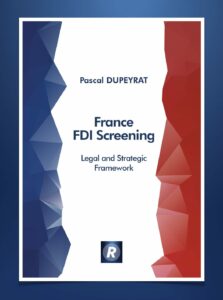
France FDI Screening: Legal and Strategic Framework (English Edition)
Author: Pascal DUPEYRAT
Publisher: Relians
Edition: 1st Edition (English Edition)
Print ISBN-13: 978-2-9584520-4-9
Ebook ISBN: 978-2-9584520-6-3
Distributor: IngramSpark
This book provides a comprehensive analysis of foreign investment screening frameworks, including the interaction between Regulation (EU) 2019-452 and national regimes.
⸻
Our expertise
Relians advises investors, funds, and industrial groups on transactions exposed to the EU foreign direct investment screening regulation.
Our expertise focuses on:
• multi-jurisdictional EU regulatory exposure
• coordination between Member States
• structuring transactions under Regulation (EU) 2019-452
• securing approvals in sensitive sectors
The EU foreign direct investment screening regulation is now a central component of transaction execution, and Relians acts as a strategic partner in navigating this complexity.