How Does the Foreign Investment Approval Process Work in France?
⸻
A Practical Guide for Investors Navigating the French Investment Screening System
France remains one of the most attractive destinations for international investment in Europe. Its strong industrial base, advanced technological ecosystem and access to the European single market make it a strategic location for cross-border acquisitions and partnerships.
At the same time, investors must take into account the regulatory framework governing foreign investments in strategic sectors. When certain conditions are met, a transaction may require authorization under the France foreign investment approval process.
The FDI approval France regime allows the French authorities to examine certain investments before they are completed in order to ensure that national security, public order and strategic economic interests are protected. For investors, financial institutions and legal advisors involved in mergers and acquisitions, understanding how the France foreign investment approval process works is therefore essential.

⸻
The Purpose of the French Foreign Investment Approval Process
The France foreign investment approval process forms part of a broader international trend. Many countries now operate mechanisms allowing authorities to review foreign acquisitions affecting critical sectors or technologies. France has progressively strengthened its framework to ensure that strategic assets remain protected while maintaining the country’s openness to international capital.
Through the FDI approval France system, the Ministry of the Economy is empowered to review investments involving sensitive activities. The authorities assess whether the transaction could affect national interests, including public security, defense capabilities, or technological sovereignty.
The France foreign investment approval process is therefore designed not to discourage foreign investors but to ensure that certain strategic activities remain safeguarded. Investors who understand how the FDI approval France regime operates are better positioned to anticipate regulatory requirements and integrate them into their transaction planning.
⸻
When Is Approval Required?
Not all foreign investments require authorization. The France foreign investment approval process applies only when specific conditions are met under French law.
First, the investor must qualify as a foreign investor.
Second, the transaction must constitute an investment within the meaning of the relevant regulations.
Third, the target company must operate activities considered sensitive under the regulatory framework.
When these conditions are satisfied, the transaction may require authorization under the FDI approval France regime before completion. Determining whether a transaction falls within the scope of the France foreign investment approval process is therefore one of the first questions investors must address when planning an acquisition.
Early identification of these conditions helps investors anticipate whether their project may trigger the FDI approval France requirement and allows them to integrate regulatory considerations into the deal structure.
⸻
The Filing of an Approval Request
When a transaction falls within the scope of the regime, the investor must submit a request for authorization to the French Ministry of the Economy. This request initiates the France foreign investment approval process.
The filing generally includes detailed information about the investor, the ownership structure, the transaction itself and the activities carried out by the target company. Authorities use this information to assess whether the investment raises concerns under the FDI approval France framework.
Preparing a comprehensive and accurate filing is a critical step in the France foreign investment approval process, as incomplete submissions may delay the review or lead the authorities to request additional information.
Legal advisors and financial institutions involved in the transaction therefore play an important role in ensuring that the filing meets the requirements of the FDI approval France procedure.
⸻
The Initial Review Phase
Once the filing has been submitted, the authorities begin the first stage of the France foreign investment approval process. During this initial review phase, the administration conducts a preliminary assessment of the transaction.
The objective is to determine whether the proposed investment raises potential concerns related to national security or strategic interests. If the authorities conclude that the transaction does not present significant risks, authorization may be granted relatively quickly under the FDI approval France framework.
This first stage of the France foreign investment approval process allows straightforward cases to be resolved efficiently, ensuring that transactions not affecting strategic sectors are not unnecessarily delayed.
For investors, this phase demonstrates how the FDI approval France regime seeks to balance regulatory oversight with the need to maintain an attractive investment environment.
⸻
The Extended Review Phase
In more complex situations, the authorities may decide to conduct a deeper investigation. This leads to a second stage of the France foreign investment approval process, often referred to as the extended review phase.
During this stage, the administration may analyze in greater detail the potential impact of the investment on strategic technologies, critical infrastructure or sensitive data. Authorities may also engage in discussions with the investor regarding possible commitments.
These commitments may include safeguards designed to protect national interests while allowing the transaction to proceed. For example, the investor may be required to maintain certain activities in France, limit access to sensitive information or implement specific governance arrangements.
The extended review phase therefore represents a key element of the FDI approval France regime, allowing authorities to address concerns while preserving the benefits of foreign investment.
⸻
Possible Outcomes of the Approval Process
The France foreign investment approval process can lead to several different outcomes depending on the nature of the transaction and the concerns identified by the authorities.
In many cases, the Ministry of the Economy grants authorization without conditions. When risks are identified but considered manageable, approval may be granted subject to commitments by the investor. These commitments are intended to ensure that the investment does not undermine national security or strategic capabilities.
In rare circumstances, the authorities may refuse authorization if the transaction is deemed incompatible with national interests under the FDI approval France framework.
Understanding these possible outcomes helps investors anticipate how the France foreign investment approval process may affect their transaction strategy.
⸻
Integrating Regulatory Review into Transaction Planning
For investors and advisors involved in cross-border acquisitions, regulatory analysis should be integrated early into the transaction planning process. Waiting until the final stages of a deal to assess whether authorization is required may create unnecessary delays.
By evaluating regulatory exposure at an early stage, investors can determine whether the transaction may fall within the scope of the France foreign investment approval process and whether a filing under the FDI approval France regime may be required.
FDI screening triggers in France
This proactive approach allows investors to structure the transaction appropriately, anticipate regulatory timelines and reduce uncertainty during the deal process.
Financial institutions, private equity funds and multinational corporations increasingly incorporate analysis of the France foreign investment approval process into their due diligence procedures.
⸻
Strategic Assessment for France Foreign Investment Transactions
Transactions involving strategic sectors or advanced technologies may require a more detailed regulatory assessment. Such analysis can help determine whether a transaction is likely to trigger the France foreign investment approval process and how the authorities may evaluate the investment under the FDI approval France regime.
Relians provides strategic and regulatory assessments for international investors, financial institutions and legal advisors involved in acquisitions in France. This analysis helps identify regulatory risks, evaluate the likelihood of authorization and anticipate the expectations of the authorities under the France foreign investment approval process.
Investors considering a transaction in France may request a preliminary strategic assessment by contacting Relians directly:
⸻
Learn More About the France Foreign Investment Review Framework
For a detailed analysis of the legal and strategic framework governing foreign investment screening in France, investors and advisors may consult the reference book:
France FDI Screening: Legal and Strategic Framework (English Edition)
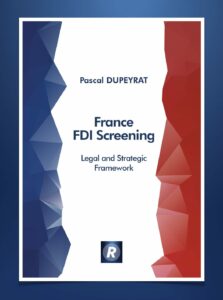
Author: Pascal DUPEYRAT
Publisher: Relians
Edition: English Edition — 1st edition
Print ISBN-13: 978-2-9584520-4-9
Ebook ISBN: 978-2-9584520-6-3
The book provides a comprehensive explanation of the legal foundations and strategic implications of the France foreign investment review regime, offering practical insights for investors, financial institutions and legal advisors navigating the foreign investment control France framework
⸻