
France FDI Screening Rules – Practical Application and Transaction Guidelines
⸻
Understanding France FDI Screening Rules in Practice
France FDI screening rules define how foreign investment control is applied in practice when transactions involve French strategic assets.
While the legal framework sets out the formal conditions and procedures, it is the practical application of these rules that determines how transactions are reviewed, negotiated and ultimately approved by the French authorities.
In practice, foreign investment control in France is not a purely mechanical process. It reflects a combination of legal analysis, administrative interpretation and broader considerations linked to economic security. As a result, the outcome of a transaction depends not only on its legal qualification but also on how it is structured, presented and positioned in relation to national interests.
In cross-border M&A transactions, understanding how France FDI screening rules operate in real situations is essential to securing deal execution. The formal timeline of 30 to 75 business days provides a regulatory framework, but the effective duration and complexity of the process are largely influenced by preparation and anticipation.
⸻
How France FDI Screening Rules Apply to Transactions
In practice, France FDI screening rules are applied through a qualitative and contextual assessment carried out by the Ministry of the Economy.
Rather than relying solely on a checklist of legal criteria, the authorities assess the broader implications of the transaction. This includes the sensitivity of the target’s activities, the strategic importance of the assets involved, the profile and origin of the investor, and the potential impact on national interests.
As a result, transactions with similar structures may be treated differently depending on their context. This reinforces the idea that France FDI screening rules must be approached as both a legal and strategic framework.
For investors, this means that anticipation, preparation and positioning are critical factors in the review process.
⸻
Practical Rules for Structuring Transactions
France FDI screening rules have a direct influence on how transactions should be structured.
In practice, investors may reduce regulatory exposure by carefully designing the structure of their investment. For example, opting for a minority position rather than acquiring control may, in certain situations, limit the likelihood of triggering an in-depth review. Similarly, adjusting governance rights or isolating sensitive activities within the target can influence how the transaction is perceived by the authorities.
These structuring choices must be made at an early stage of the transaction. Once the deal is advanced, the room for adjustment becomes significantly more limited.
In this context, France FDI screening rules should be considered not only as constraints but also as strategic parameters that can be integrated into deal design.
⸻
Filing Rules and Best Practices
The application of France FDI screening rules is heavily influenced by the quality of the filing submitted to the authorities.
A well-prepared filing requires a clear and precise description of the target’s activities, a transparent presentation of the investor’s ownership structure, and a coherent explanation of the transaction rationale. It is also important to anticipate the questions that may arise during the review and to address potential concerns proactively.
In practice, early preparation and coordination between legal, financial and operational teams are essential. Inconsistencies or omissions in the filing may lead to delays, additional scrutiny or the opening of an in-depth review.
A structured and strategic approach to the filing process can significantly improve the efficiency and predictability of the review.
⸻
How Authorities Assess Transactions in Practice
France FDI screening rules are applied within a broader decision-making framework that goes beyond purely legal considerations.
The French authorities may take into account geopolitical developments, industrial policy objectives and the need to preserve technological sovereignty. The continuity of critical infrastructure and the protection of strategic capabilities are also key elements of the assessment.
The review process is often dynamic and may involve informal exchanges between the parties and the administration. This interaction plays an important role in clarifying the transaction and addressing potential concerns.
Understanding how the authorities approach these assessments is essential for anticipating outcomes and managing the process effectively.
⸻
Common Pitfalls in France FDI Screening Rules
In practice, several recurring issues can affect the outcome of transactions subject to France FDI screening rules.
One of the most common challenges is the incorrect qualification of the transaction, particularly when the scope of sensitive activities is underestimated. Another frequent issue is the late identification of regulatory exposure, which may disrupt the transaction timeline.
Insufficient preparation of the filing or inconsistencies in the information provided can also lead to additional scrutiny. In some cases, a lack of strategic alignment in communication with the authorities may complicate the review process.
Avoiding these pitfalls requires early analysis, careful preparation and a clear understanding of how France FDI screening rules are applied in practice.
⸻
Practical Timeline of France FDI Screening
Although France FDI screening rules are structured around a formal two-phase procedure, the practical timeline of a transaction begins well before the official filing.
The initial stage involves assessing regulatory exposure and structuring the transaction accordingly. This phase is critical, as it determines how the transaction will be presented to the authorities.
Once the filing is submitted, the initial review phase allows the administration to conduct a preliminary analysis. In some cases, informal exchanges may take place to clarify specific aspects of the transaction.
If an in-depth review is initiated, the process becomes more interactive and may involve detailed discussions, additional information requests and the negotiation of commitments aimed at protecting national interests.
In practice, the preparation phase is often as important as the formal review itself.
⸻
France FDI Screening Rules and Deal Execution Strategy
France FDI screening rules play a central role in shaping deal execution strategy.
In competitive M&A processes, the ability to anticipate regulatory expectations can strengthen the credibility of a bidder and facilitate discussions with sellers. It can also help to secure more predictable timelines and reduce execution risk.
From a contractual perspective, these rules influence the allocation of regulatory risk, particularly through conditions precedent and specific regulatory clauses.
Investors who integrate France FDI screening rules into their strategy from the outset are better positioned to manage complexity and secure successful outcomes.
⸻
France FDI Screening Rules vs Mechanism and Regulation
It is important to distinguish between the different dimensions of foreign investment control in France.
The France FDI screening mechanism refers to the operational process through which transactions are reviewed. The France FDI screening regulation defines the legal framework governing this process. France FDI screening rules reflect how the system operates in practice, based on administrative interpretation and experience.
These three dimensions are complementary and must be considered together to fully understand the regime.
For a broader overview, readers may refer to the pages dedicated to the France FDI screening mechanism and the France FDI screening regulation.
⸻
Further Reading
France FDI Screening – Legal and Strategic Framework
Pascal DUPEYRAT – Relians
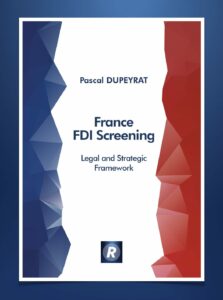
This book provides a comprehensive analysis of the French foreign investment control regime, including its legal foundations, its interaction with European and international frameworks such as CFIUS, and its implications for transaction strategy.
⸻
Our Expertise – Relians
Relians is a strategic advisory firm specialized in foreign investment screening and economic security.
For more than twenty years, Relians has supported international investors, private equity funds and industrial groups in navigating complex regulatory environments and securing cross-border transactions.
The firm combines legal expertise, transactional experience and institutional insight to assist clients at every stage of the process, from initial assessment to regulatory approval.
⸻
Secure Your Transaction Under France FDI Screening Rules
Before executing a transaction, it is essential to understand how France FDI screening rules will apply in practice.
This requires not only a legal analysis but also a strategic assessment of how the transaction will be perceived by the authorities. Early anticipation allows investors to structure their deals appropriately and reduce uncertainty.
You can use our FDI diagnostic to evaluate your exposure and identify potential risks. You may also contact Relians to benefit from tailored support in structuring transactions and managing regulatory processes.