
What Triggers FDI Filing in France?
⸻
Understanding what triggers an FDI filing in France is a prerequisite for any investor seeking to execute a cross-border transaction involving French assets.
But in practice, identifying whether an FDI filing is required is only the first step.
The real challenge lies in anticipating how the transaction will be perceived by the French authorities—and whether it will be authorized.
This is where many deals fail.
An FDI filing is not just a regulatory formality. It is a decision point that can validate—or block—an entire transaction.
This article explains what triggers an FDI filing, where the real risks lie, and how investors can move from uncertainty to execution.

⸻
The Three Legal Triggers of an FDI Filing
From a legal standpoint, an FDI filing is required when three cumulative criteria are met:
• a foreign investor
• a qualifying transaction (control, threshold, or influence)
• a sensitive activity
This framework appears clear.
However, in practice, each of these criteria is interpreted broadly by the administration, which significantly expands the situations where an FDI filing may be required.
As a result, many investors underestimate their exposure.
⸻
Trigger #1: A Broad Definition of Foreign Investor
The first trigger of an FDI filing is the foreign nature of the investor.
This includes:
• non-French individuals or entities
• foreign-controlled French companies
• investment funds with international structures
• entities with non-French ultimate beneficial owners
Even when a deal is structured through a French vehicle, an FDI filing may still be required if foreign control exists upstream.
This creates a first level of uncertainty: many transactions assumed to be domestic in nature still fall within the scope of an FDI filing.
⸻
Trigger #2: Control, Thresholds, and Strategic Influence
The second trigger relates to the level of control or influence acquired.
An FDI filing is required in cases of:
• acquisition of control
• crossing voting rights thresholds (typically 25%)
• acquisition of a business line
But beyond these formal thresholds, the administration also looks at effective influence.
This is where risk intensifies.
An investor may trigger an FDI filing through:
• board representation
• veto rights
• access to sensitive data
• operational involvement
In other words, even a minority position can lead to an FDI filing if it creates strategic leverage.
⸻
Trigger #3: Sensitive Sectors and Expanding Scope
The third trigger concerns the activities of the target.
An FDI filing is required when the company operates in a sensitive sector, such as:
• defense and dual-use technologies
• cybersecurity and data infrastructure
• energy and critical infrastructure
• healthcare and biotech
• artificial intelligence
The critical issue is that these sectors are not static.
Their scope is expanding.
Today, many companies are only partially exposed—yet still trigger an FDI filing.
This partial exposure is one of the most frequent sources of miscalculation.
⸻
The Real Risk: The Grey Zone of FDI Filing
Most transactions do not fall into a clear “yes” or “no” category.
They fall into a grey zone.
In this grey zone, the need for an FDI filing depends on:
• how the transaction is structured
• how the target’s activities are interpreted
• how the investor profile is perceived
• the broader political and economic context
This is where the risk becomes strategic.
Failure to anticipate an FDI filing in this zone can result in:
• deal delays
• regulatory intervention
• renegotiation of terms
• transaction failure
At this stage, the question is no longer legal.
It is: will the deal go through?
⸻
Structuring Effects: When the Deal Itself Triggers Filing
An FDI filing is not only triggered by the nature of the asset.
It is also triggered by how the deal is structured.
Key elements include:
• governance rights
• shareholder agreements
• staged acquisitions
• control mechanisms embedded in contracts
A poorly structured deal may trigger an FDI filing unnecessarily—or make approval more difficult.
Conversely, a well-structured transaction can:
• reduce regulatory friction
• clarify the investor’s intent
• align with State expectations
This is where structuring becomes a decisive factor in managing FDI filing risk.
⸻
Timing Risk: The Cost of Getting It Wrong
Even when an FDI filing is identified, timing remains critical.
The filing must be anticipated early.
If it is identified too late, the consequences are immediate:
• disruption of the deal timeline
• loss of competitive positioning
• increased execution uncertainty
In competitive processes, this can be decisive.
Sellers prioritize buyers who can secure execution.
An investor who has not anticipated the FDI filing dimension is structurally disadvantaged.
⸻
From Filing to Approval: The Strategic Gap
At this point, a key misunderstanding must be addressed.
Submitting an FDI filing does not mean obtaining approval.
Between filing and authorization lies a strategic gap.
This gap includes:
• regulatory review
• institutional dialogue
• potential conditions or commitments
• political sensitivity
Many investors approach the FDI filing as a compliance step.
In reality, it is an approval process that must be actively managed.
This is where execution risk concentrates.
⸻
How Investors Lose Control of the Process
In many transactions, investors lose control at the FDI filing stage because:
• the filing is treated too late
• the narrative is not aligned with State expectations
• the sensitivities of the target are underestimated
• the process is handled purely from a legal standpoint
As a result, the FDI filing becomes a constraint rather than a controlled step.
This is precisely what differentiates successful transactions from failed ones.
⸻
Moving from Uncertainty to Execution
At this stage, the objective is not simply to determine whether an FDI filing is required.
The objective is to:
• qualify the level of risk
• anticipate the administration’s reaction
• structure the deal accordingly
• secure the approval path
This requires a shift in approach.
From compliance to strategy.
From filing to execution.
⸻
Relians Diagnostic: Assess Your FDI Filing Risk
If you are considering an acquisition in France, the key question is not:
“Do I need an FDI filing?”
But:
“Is my transaction structured to obtain approval?”
Relians has developed a diagnostic approach specifically designed to answer this question.
This assessment allows investors to:
• determine whether an FDI filing is likely required
• identify hidden risk factors
• map the transaction’s sensitivity profile
• anticipate potential obstacles
• define an approval strategy
This is not a legal checklist. It is an execution-focused analysis.

⸻
Why This Matters Before You Move Forward
In sensitive transactions, uncertainty around FDI filing is one of the primary causes of deal failure.
Investors who address this question early can:
• secure their timeline
• strengthen their bid
• avoid costly restructuring
• increase their probability of approval
Those who do not remain exposed to a structural risk.
⸻
FDI Filing as a Strategic Gate
An FDI filing is not just triggered by legal criteria.
It is triggered by how a transaction interacts with the State.
Understanding this interaction is the key to execution.
In France, deals do not fail because they are poorly structured financially.
They fail because they are not aligned with regulatory and institutional expectations.
Anticipating an FDI filing is therefore not optional.
It is a strategic imperative.
⸻
FAQ: FDI Filing in France
When is an FDI filing mandatory?
An FDI filing is mandatory when a foreign investor acquires control or influence over a French company operating in a sensitive sector.
Can a minority investment trigger an FDI filing?
Yes. An FDI filing may be required if the investment grants strategic influence or exceeds regulatory thresholds.
What is the main risk related to FDI filing?
The main risk is not the filing itself, but the uncertainty of approval following the FDI filing.
Can an FDI filing be avoided through structuring?
In some cases, structuring may reduce exposure—but it must be carefully assessed to avoid unintended consequences.
How can investors assess their situation?
A structured diagnostic allows investors to determine whether an FDI filing is required and how to secure the transaction.
Further reading
For a detailed analysis of the French foreign investment screening regime, see:
France FDI Screening: Legal and Strategic Framework (English Edition)
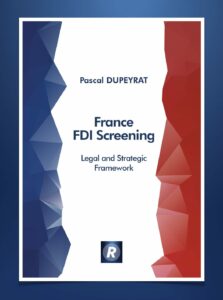
Author: Pascal DUPEYRAT
Publisher: Relians
Edition: English Edition — 1st edition
Print ISBN-13: 978-2-9584520-4-9
Ebook ISBN: 978-2-9584520-6-3
The book provides a comprehensive explanation of the legal foundations and strategic implications of the France foreign investment review regime, offering practical insights for investors, financial institutions and legal advisors navigating the foreign investment control France framework.
⸻