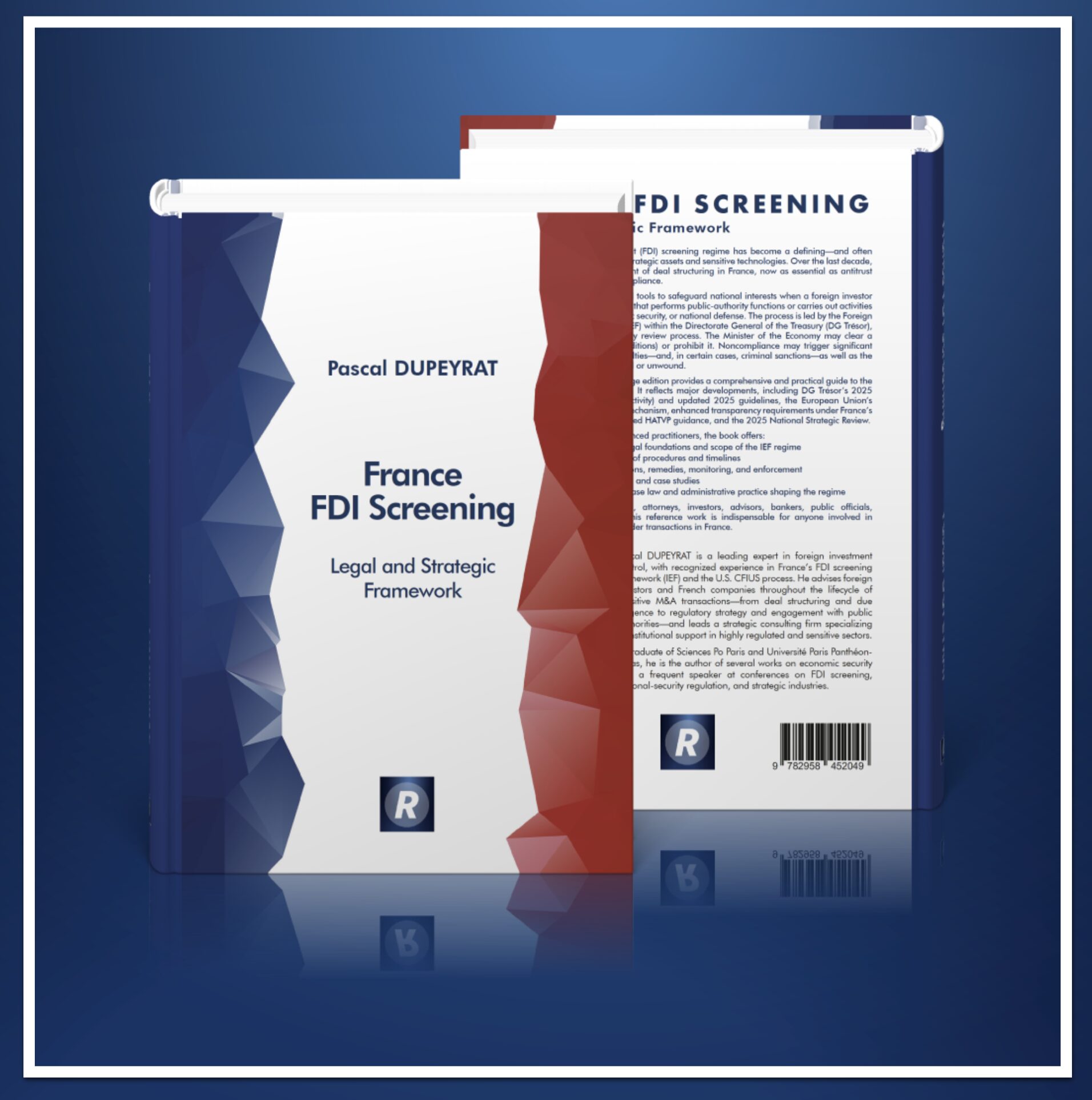
FDI Control – France FDI Screening book
-
Title: France FDI Screening: Legal and Strategic Framework (English Edition)
-
Language: English
-
Author: Pascal DUPEYRAT
-
Publisher / Imprint: Relians
-
Edition: English Edition — 1st edition
-
Print ISBN-13: 978-2-9584520-4-9 (9782958452049) – Barns&Noble
- Ebook ISBN: 978-2-9584520-6-3 (9782958452063) – Booktopia – Lehmans – Hugendubel – RakutenKobo – OrellFüssli –
-
Distributor: IngramSpark
A Deal Reality That Has Moved to the Center of Execution
Cross-border acquisitions and minority investments touching strategic assets or sensitive technologies in France increasingly hinge on the same operational question: can the parties manage national-security review without compromising timing, value, or the post-closing operating model. In practice, FDI Control has shifted from a specialized compliance checkpoint to a structuring constraint that affects diligence priorities, governance design, financing conditionality, and the credibility of the overall deal narrative. The France FDI Screening Book is written for practitioners who need to integrate that constraint into transaction management from the outset, with the discipline expected in sophisticated M&A processes.
What the France FDI Screening Book Is Designed to Provide
The France FDI Screening Book is a practitioner reference that connects legal doctrine to institutional practice and deal mechanics. Its objective is not merely to describe the French screening regime, but to help teams anticipate how the administration evaluates a file, how interagency review behaves, and how outcomes translate into transaction terms and operational obligations. For transaction counsel and advisors, the value is practical: the book helps teams run FDI Control as a defined workstream—scoped, sequenced, documented, and aligned across internal stakeholders and external advisors.
Legal Qualification Under Real Deal Facts
Screening analysis rarely starts from clean, static facts. Ultimate ownership may be layered; investor identity and governance arrangements may involve affiliates, co-investors, or complex voting arrangements. Transaction rights can be distributed across shareholder agreements, vetoes, board seats, reserved matters, and information rights. Meanwhile, the target’s sensitive perimeter can sit across functions (R&D, IT, production, data, security), contracts, customers, and infrastructure dependencies. The France FDI Screening Book provides a structured approach to qualification that is consistent with how deal teams actually operate: map the investor profile, map the contemplated rights, map sensitive activities, and keep the resulting narrative consistent across diligence outputs and legal documentation. This is where FDI Control analysis begins to create or preserve deal certainty.
Institutional Practice: DG Trésor and Interagency Review
The review is led by the Foreign Investment Screening Bureau (CIEF) within the Directorate General of the Treasury (DG Trésor) and conducted through an interagency process. For practitioners, this means the same factual set will be examined through multiple lenses—defense relevance, cybersecurity posture, continuity of supply, protection of sensitive information, industrial footprint, resilience, and preservation of know-how. The France FDI Screening Book explains how to build a filing narrative that remains coherent across those perspectives and how to avoid contradictions that trigger iterative requests and delay. In a process shaped by institutional confidence, coherence is not cosmetic; it is a core driver of how a FDI Control file is handled.
Due Diligence: Mapping the Sensitive Perimeter with Transaction-Grade Precision
Effective diligence for screening purposes goes beyond sector labeling. It requires identifying where sensitive capabilities sit, how information and systems are controlled, which contracts and customers are material, and what operational dependencies exist. The France FDI Screening Book is organized to support that diligence exercise with a practitioner mindset: define the sensitive perimeter at the level needed to withstand administrative scrutiny, and ensure the resulting description is stable across the data room, management presentations, board materials, and the submission itself. For bankers, analysts, and counsel, this discipline supports more credible timing assumptions and better forecasting of remedy likelihood, because FDI Control outcomes tend to track the quality and stability of the sensitive-perimeter narrative.
Deal Structuring and Documentation: Turning Screening into Draftable Architecture
Screening is rarely just a regulatory step; it is a constraint that can reshape deal design. It may influence governance rights, access to sensitive information, integration planning, and the feasibility of combining functions post-closing. The France FDI Screening Book is built to help teams translate screening risk into the transaction’s “hard wiring”: conditions precedent, cooperation covenants, interim operating covenants, long-stop dates, termination rights, and—where relevant—risk-sharing provisions. It also addresses why certain drafting choices can weaken credibility during review (for example, overly expansive information rights or unclear governance arrangements) and how disciplined drafting can preserve deal rationale while remaining compatible with FDI Control expectations.
Procedures and Timelines: Controlling Volatility on the Critical Path
In cross-border transactions, the principal execution challenge is rarely the existence of a review, but the volatility introduced by incomplete submissions, late re-scoping, or internal misalignment. The France FDI Screening Book provides a step-by-step walkthrough of procedures and timelines with emphasis on what teams can control: completeness discipline at the outset, internal ownership and escalation rules, version control for supporting documentation, and coherent coordination among counsel and advisors. These operational choices materially influence whether review proceeds on a predictable track or becomes iterative. Properly sequenced and documented, the FDI Control workstream becomes manageable rather than destabilizing.
Clearance, Conditional Clearance, or Prohibition: Understanding the Practical Decision Tree
The Minister of the Economy may clear a transaction (with or without conditions) or prohibit it. In sensitive operations, conditional clearance is often the realistic scenario that drives the negotiation. The France FDI Screening Book approaches this decision tree with a transaction lens: how to anticipate the subjects likely to trigger conditions, how to position an operating model that preserves safeguards for sensitive activities, and how to maintain a narrative that remains credible under interagency review. A central contribution of the book is that it treats remedies as deal instruments, not abstract policy tools, and it frames how FDI Control outcomes can be planned for—rather than absorbed as last-minute surprises.
Remedies and Conditions: Designing Commitments That Can Be Implemented
Conditions may touch governance, security protocols, data and information flows, technology transfer constraints, localization requirements, continuity commitments, or ring-fencing measures. The difference between a workable remedy package and a problematic one is frequently operational feasibility and auditability, not merely drafting elegance. The France FDI Screening Book provides a practitioner framework for remedy design and negotiation, focusing on four criteria that matter in both administrative credibility and day-to-day operation: specificity, proportionality, enforceability, and sustainability. This is also where transaction teams must reconcile integration plans with compliance architecture, because FDI Control commitments typically become enduring operating constraints.
Post-Authorization Monitoring: Treating Compliance as a Lifecycle
Authorization is often the start of a compliance lifecycle rather than the end of the transaction story. Monitoring and reporting obligations may persist after closing and require durable governance across legal, compliance, security, IT, HR, and operations. The France FDI Screening Book treats monitoring as integral to transaction planning: commitments should be drafted in a way that can be operationalized, evidenced, and maintained over time. It also explains how to build internal ownership, escalation paths, and documentation routines that generate audit-ready evidence. This is essential because the credibility of the operating model—and the stability of the transaction post-closing—depends on sustained compliance with FDI Control commitments.
Enforcement Exposure: Why Consistency and Evidence Are Deal Issues
Noncompliance may trigger significant administrative and financial penalties—and in certain cases criminal sanctions—as well as the risk that a transaction be voided or unwound. Enforcement exposure can arise from incomplete filings, inconsistent descriptions of rights or activities, or failures to implement commitments after closing. The France FDI Screening Book explains how these risks typically emerge and how transaction teams can reduce exposure through disciplined documentation, consistent narratives across deal documents, and monitoring-ready commitments. For lenders and investment committees, this matters because enforcement scenarios and remedy constraints can affect downside analysis and the bankability of the transaction under FDI Control.
Legal, Regulatory, Institutional, and Political Context—Applied to Transaction Strategy
FDI screening is a legal instrument embedded in a broader economic security agenda. That context influences sensitivity assessments, priority sectors, and the calibration of conditions and monitoring. The France FDI Screening Book integrates these layers—legal tests, administrative practice, institutional incentives, and policy direction—while keeping the practitioner’s objective in view: build a credible strategy that supports clearance, preserves deal rationale, and remains sustainable post-closing. The practical benefit is strategic: teams gain a clearer understanding of how their transaction is likely to be perceived and how to position the file accordingly, which is central to navigating FDI Control efficiently.
What You Will Find Inside the France FDI Screening Book
The France FDI Screening Book is structured for use during live transactions and designed for both new and experienced practitioners. It includes:
• Clear explanations of the legal foundations and scope of the IEF regime
• A step-by-step walkthrough of procedures and timelines
• Detailed insight into conditions, remedies, monitoring, and enforcement
• Practical diagrams, annexes, and case studies
• A rigorous overview of the case law and administrative practice shaping the regime
For deal teams, these components function as a practical baseline for FDI Control in France—supporting diligence, drafting, regulatory engagement, and post-closing governance.
Intended Audience: Transaction Teams and Their Advisors
The France FDI Screening Book is written for in-house counsel, business attorneys, cross-border M&A advisors, investment bankers, analysts, investors, and compliance teams working on sensitive or regulated transactions in France. Its organization mirrors the deal lifecycle: early qualification, sensitive-perimeter mapping, documentation strategy, regulatory engagement, remedy negotiation, and monitoring. That structure helps teams standardize internal processes, reduce misalignment across workstreams, and improve the quality of execution in matters where timing and coherence directly affect outcomes.
Author Bio
Pascal DUPEYRAT is a leading expert in foreign investment control, with recognized experience in France’s FDI screening framework (IEF) and the U.S. CFIUS process. He advises foreign investors and French companies throughout the lifecycle of sensitive cross-border M&A transactions—from deal structuring and due diligence to regulatory strategy and engagement with public authorities—and leads a strategic consulting firm specializing in institutional support in highly regulated and sensitive sectors.
A graduate of Sciences Po Paris and Université Paris Panthéon-Assas, he is the author of several works on economic security and a frequent speaker at conferences on screening, national-security regulation, and strategic industries. His practice-based perspective informs the France FDI Screening Book’s focus on execution: translating legal requirements into workable deal architecture, credible filings, and durable compliance programs.
Practical Conclusion: Why the Book Matters for France Deals
In sensitive cross-border operations, the teams that perform best are those that treat screening as a structured, evidence-driven workstream—one that is integrated into deal governance, diligence, documentation, and post-closing compliance. The France FDI Screening Book is designed to support that approach. It helps teams define the sensitive perimeter, describe control and influence with precision, anticipate interagency concerns, design implementable remedies, and build monitoring that can be sustained over time. For practitioners navigating FDI Control in France, the most effective strategy is to standardize on a reference that links law, institutional practice, and transaction mechanics. That is the role the France FDI Screening Book is intended to play.