⸻
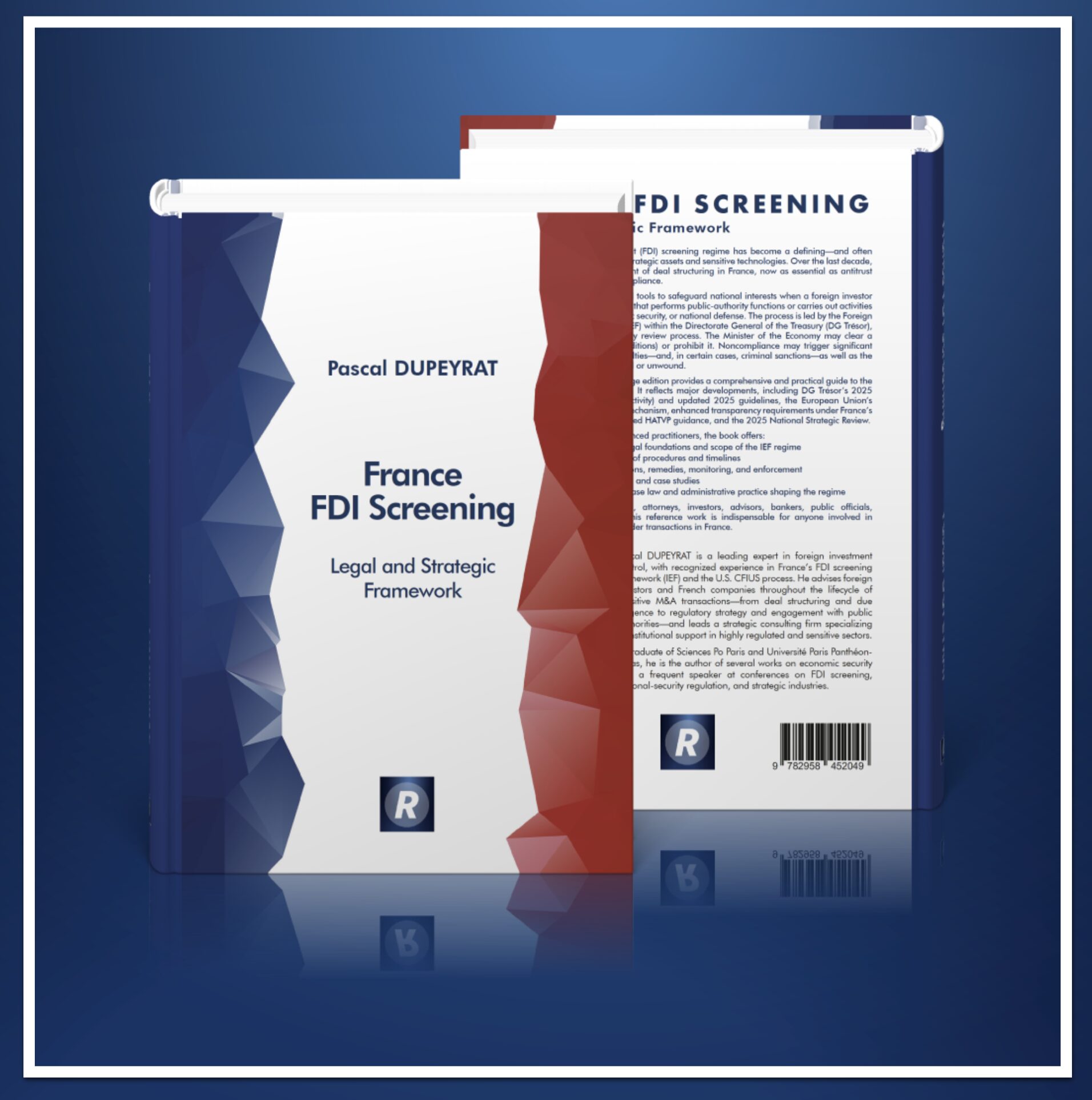
France FDI Screening book—Legal and Strategic Framework
-
Title: France FDI Screening: Legal and Strategic Framework (English Edition)
-
Language: English
-
Author: Pascal DUPEYRAT
-
Publisher / Imprint: Relians
-
Edition: English Edition — 1st edition
-
Print ISBN-13: 978-2-9584520-4-9 (9782958452049) – Barns&Noble
- Ebook ISBN: 978-2-9584520-6-3 (9782958452063) – Booktopia – Lehmans – Hugendubel – RakutenKobo – OrellFüssli –
-
Distributor: IngramSpark
⸻
A Transaction Workstream That Now Determines Deal Certainty
France’s foreign direct investment (FDI) screening regime has become a routine—but often decisive—step in cross-border M&A involving strategic assets, sensitive technologies, and regulated capabilities. In practice, screening is no longer a discrete “filing item” delegated late in the process. It has become a structuring variable that can affect valuation assumptions, governance architecture, signing-to-closing sequencing, financing conditionality, and post-closing integration planning. The France FDI Screening book is written for teams that need to manage this reality with transaction discipline—treating screening as a core workstream that must be modeled early, documented consistently, and executed with institutional credibility.
⸻
What This Reference Is Intended to Achieve
The purpose of the France FDI Screening book is practical: to help practitioners understand which operations are likely to be caught by the French regime, how the administration evaluates risk, and how to translate that understanding into a coherent strategy across diligence, documentation, and engagement with public authorities. The book connects legal tests to operational consequences, with a deal-oriented emphasis on issues that drive outcomes: control and influence analysis, mapping the sensitive perimeter, anticipating interagency questions, designing workable remedies, and building monitoring-ready compliance. It is designed for business attorneys, cross-border M&A advisors, investment banking teams, analysts, and in-house legal and compliance functions who need a structured, repeatable method for sensitive transactions in France.
⸻
The Legal Perimeter and the “Control or Influence” Question
From a practitioner standpoint, the first challenge is not theoretical scope, but correct qualification of the transaction in context: investor profile, ultimate ownership, contemplated rights, and the target’s sensitive activities. Legal tests can appear straightforward in isolation, but transactions rarely present clean facts. Governance rights can be layered through shareholder agreements, vetoes, board composition, reserved matters, or information rights. The France FDI Screening book provides a disciplined approach to analyzing how “control” and “influence” may be perceived by the administration, and how to describe those rights with precision across the filing, internal approvals, and transaction documents. For due diligence teams, that precision reduces avoidable contradictions and mitigates the risk that the review turns into iterative re-scoping under time pressure.
⸻
Institutional Reality: DG Trésor and Interagency Review
The process is led by the Foreign Investment Screening Bureau (CIEF) within the Directorate General of the Treasury (DG Trésor), operating through an interagency review process. In live deals, interagency coordination is not a procedural detail—it is a substantive feature that shapes the review’s questions, evidence expectations, and remedy preferences. Different administrations may view the same target through distinct lenses: defense readiness, cybersecurity posture, continuity of supply, protection of sensitive information, integrity of governance, industrial footprint, or preservation of critical know-how. The France FDI Screening book helps deal teams build a narrative that remains coherent across those lenses—anchored in verifiable facts, aligned with the legal basis, and compatible with the operating model the parties intend to implement post-closing.
⸻
Due Diligence: Mapping the Sensitive Perimeter Without Overreach
Diligence in this area is not limited to identifying “sensitive sectors” in the abstract. It requires mapping the target’s activities at a level of granularity that is defensible and stable under scrutiny: what the business actually does, where sensitive capabilities sit, which contracts or customers are relevant, and how technology, data, and operational dependencies are managed. The France FDI Screening book is designed to support that diligence effort by providing a structured way to document the sensitive perimeter and to keep the narrative consistent across diligence memoranda, management presentations, and the submission itself. For bankers and analysts, that structure is directly linked to execution risk: a clear perimeter supports more reliable timing assumptions and a more credible assessment of remedy likelihood.
⸻
Transaction Documentation: Turning Screening Risk Into Deal Terms
Screening outcomes influence how parties allocate risk and preserve optionality. In practice, that means translating screening into contractual architecture: conditions precedent, cooperation covenants, information undertakings, interim operating covenants, long-stop dates, termination rights, and, where relevant, reverse break fees or other risk-sharing devices. The France FDI Screening book provides a transaction-oriented lens on how screening interacts with these provisions and how drafting choices may affect the credibility of the filing. For example, overly aggressive governance rights or poorly described information flows can undermine the narrative that the operating model preserves safeguards for sensitive functions. Conversely, well-structured commitments can reduce friction and improve the plausibility of clearance under workable conditions.
⸻
Procedures and Timelines: Managing the Critical Path Under Constraints
Timing discipline is central to cross-border M&A, particularly when multiple regulatory tracks run in parallel. Screening can become the critical path when the sensitive perimeter is uncertain, when the investor profile raises heightened questions, or when remedy negotiations are likely. The France FDI Screening book offers a step-by-step walkthrough of procedures and timelines, emphasizing what deal teams can control: completeness of the initial submission, internal governance for approvals and version control, alignment among advisors, and early identification of issues likely to trigger interagency attention. The practical objective is to reduce timeline volatility by minimizing avoidable rework and by aligning the transaction narrative from the outset.
⸻
Conditions and Remedies: Designing Commitments That Are Implementable
The Minister of the Economy may clear a transaction (with or without conditions) or prohibit it. In sensitive deals, conditional clearance is frequently the operative scenario, and remedy design becomes the technical center of gravity. Conditions may affect governance, operational controls, security protocols, information flows, or technology transfer constraints. They may also require ring-fencing of sensitive activities or limitations on integration planning. The France FDI Screening book approaches remedies as negotiated instruments that must satisfy public objectives while remaining sustainable for the business. It emphasizes four practitioner criteria: specificity, proportionality, enforceability, and operational feasibility. A remedy that cannot be implemented consistently is not merely inconvenient—it creates future enforcement exposure.
⸻
Post-Authorization Monitoring: Building Auditability Into the Operating Model
Authorization often marks the start of a compliance lifecycle. Monitoring and reporting obligations can persist after closing and require durable internal governance across legal, compliance, security, IT, HR, and operations. The France FDI Screening book treats monitoring as an integral element of transaction planning, not an afterthought. For deal teams, that means ensuring remedies are drafted in a way that can be operationalized and evidenced, with clear internal ownership and escalation paths. For in-house counsel, it means building a compliance architecture that survives personnel changes and that can generate reliable documentation when audits or follow-up requests arise.
⸻
Enforcement and Sanctions: Why Credibility and Consistency Matter
Noncompliance may trigger substantial administrative and financial penalties—and, in certain cases, criminal sanctions—as well as the risk that a transaction be voided or unwound. Enforcement exposure is not limited to willful misconduct. It can arise from incomplete filings, inconsistent descriptions of governance rights, or failure to operationalize commitments post-closing. The France FDI Screening book provides a rigorous overview of how enforcement risk emerges in practice and how transaction teams can reduce that risk through disciplined documentation, consistent messaging, and monitoring-ready commitments. For lenders and bankers, this matters because enforceability and compliance obligations can affect covenant analysis, integration timelines, and downside scenarios.
⸻
Legal, Regulatory, Institutional, and Political Context—Without Losing Deal Focus
FDI screening is a legal instrument embedded in a broader economic security agenda. That agenda influences how institutions prioritize strategic sectors, how they interpret sensitivity, and how they calibrate conditions and monitoring expectations. Developments reflected in DG Trésor’s reporting and guidance, and in the broader European discussion of screening reforms and transparency expectations, reinforce a direction of travel toward greater institutionalization and accountability. The France FDI Screening book integrates these layers—legal doctrine, administrative practice, institutional incentives, and policy context—while keeping the practitioner’s objective in view: a coherent strategy that supports clearance, preserves deal rationale, and creates sustainable post-closing compliance.
⸻
What You Will Find Inside
Written for both new and experienced practitioners, the France FDI Screening book offers a transaction-ready reference that can be used during live deals, including:
• Clear explanations of the legal foundations and scope of the IEF regime
• A step-by-step walkthrough of procedures and timelines
• Detailed insight into conditions, remedies, monitoring, and enforcement
• Practical diagrams, annexes, and case studies
• A rigorous overview of the case law and administrative practice shaping the regime
⸻
Intended Audience: Transaction Teams and Their Advisors
The France FDI Screening book is designed for in-house counsel, attorneys, investors, advisors, bankers, analysts, public officials, policymakers, and academics. Its structure reflects the rhythm of cross-border transactions: early qualification, diligence scoping, documentation strategy, regulatory engagement, remedy negotiation, and post-closing compliance. For business attorneys and M&A advisors, the book provides legal and procedural clarity grounded in institutional practice. For bankers and analysts, it supports more reliable assessments of timing and conditionality. For in-house teams, it offers a framework to coordinate internal stakeholders and maintain consistent documentation across functions.
⸻
Author Bio
Pascal DUPEYRAT is a leading expert in foreign investment control, with recognized experience in France’s FDI screening framework (IEF) and the U.S. CFIUS process. He advises foreign investors and French companies throughout the lifecycle of sensitive cross-border M&A transactions—from deal structuring and due diligence to regulatory strategy and engagement with public authorities—and leads a strategic consulting firm specializing in institutional support in highly regulated and sensitive sectors.
The France FDI Screening book reflects this practice-based perspective: a focus on execution, coherence, and institutional credibility, aligned with the expectations of transaction counsel, investment banking teams, and compliance functions operating under real deal constraints.